
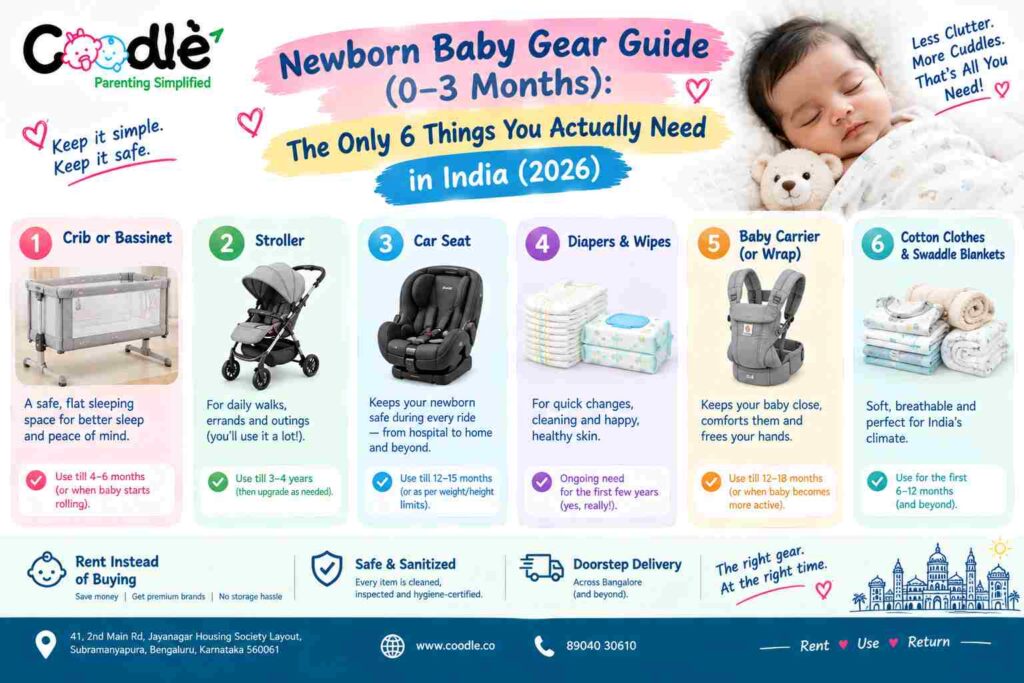
If you are expecting your first baby in India, you have probably already noticed the problem: everyone — from baby stores to well-meaning relatives to Instagram ads — is telling you that you need dozens of products before your newborn arrives. The truth is far simpler, and far kinder to your budget. In the first three months, a newborn’s needs are genuinely minimal.
This guide strips the newborn stage back to what actually matters. Instead of a 40-item shopping list, we cover the only 6 categories of baby gear a 0–3 month old truly needs in India — plus exactly what to rent, what to buy, and what to skip entirely. Following this approach can save new parents ₹20,000–₹40,000 in the first few months alone.
Everything here is written for the Indian context: Indian apartment sizes, Indian weather, Indian car and travel realities, and the way Indian families actually raise newborns — often with grandparents and extended family involved.
Why the First 3 Months Need So Little Gear
Newborns do three things: sleep, feed, and be held. That is genuinely the whole list for the first several weeks. They do not sit, crawl, play with toys, eat solids, or need entertainment gadgets. Almost every product marketed for the 0–3 month stage is either unnecessary or duplicates something you already have.
The other reason to keep newborn gear minimal is time: babies outgrow the newborn stage in weeks. A product bought specifically for a 0–3 month old may be used for 6–10 weeks before it is redundant. This is exactly why renting the large, expensive items makes so much more financial sense than buying them outright — a point we return to throughout this guide.
The 6 Newborn Essentials Every Indian Parent Actually Needs
1. A Safe, Flat Sleep Surface (Crib, Bassinet or Co-Sleeper)
Where your baby sleeps is the single most important safety decision in the newborn stage. Your baby will sleep 16–18 hours a day, so the sleep surface is used more than any other piece of gear. It must be firm, flat, and free of soft bedding, pillows, and bumpers.
✦ What to choose: A crib, a bassinet, or a bedside co-sleeper — all safe when they have a firm flat mattress and meet the safe-sleep basics.
✦ Rent or buy: RENT. A newborn uses a bassinet or newborn sleep setup for only 3–5 months. Renting a crib or co-sleeper costs a fraction of buying one you will retire within months.
✦ Skip: Expensive branded bassinets sold as ‘4th trimester solutions’ — a rented compact crib does the same job at a fraction of the cost.
2. An Infant Car Seat (Rear-Facing)
From the very first journey — the drive home from the hospital — your newborn needs a rear-facing infant car seat. India’s Motor Vehicles Act requires car seats for children under 4, and physics does not care whether the drive is 5 minutes or 50. This is a non-negotiable safety essential, not an optional extra.
✦ What to choose: A rear-facing infant carrier seat rated from birth (0–13 kg). Rear-facing is the safest orientation for newborns.
✦ Rent or buy: RENT if you drive occasionally or use cabs, or BUY if you drive daily for 12+ months. A rented infant seat covers the newborn stage perfectly and can be swapped for a larger seat as your baby grows.
✦ Skip: Combination travel-system bundles at full retail — rent the car seat independently instead.
3. Feeding Supplies
Whether you breastfeed, formula-feed, or combine both, feeding gear for a newborn is refreshingly simple and inexpensive. These are personal-use items you should own, not rent.
✦ If breastfeeding: A nursing pillow makes long feeds more comfortable. A few muslin cloths for burping. Nursing bras and pads.
✦ If formula or combination feeding: 2–4 newborn-size bottles, a bottle brush, and formula. A sterilising method (a pot of boiling water works perfectly — a dedicated steriliser is optional).
✦ Skip: Bottle warmers (warm water works), elaborate steriliser machines, and formula-preparation gadgets.
4. Clothing and Swaddles
Newborns need simple, soft, easy-to-change clothing. In India’s varied climate — from Bangalore’s mild evenings to Delhi winters to coastal humidity — layering matters more than heavy individual garments.
✦ What to buy: 6–8 soft cotton onesies or jhablas, 4–6 swaddle cloths, a few pairs of socks and mittens, and 2–3 warmer layers if you are in a cooler region.
✦ Swaddles: Muslin swaddle cloths are the most versatile — they double as feeding covers, pram shades, and burp cloths.
✦ Skip: Elaborate outfit sets, shoes (newborns do not need shoes), and anything that has to go over the head with force.
5. A Nappy-Changing Setup
Newborns go through 8–12 nappies a day, so a simple, repeatable changing setup saves your sanity. You do not need a dedicated changing table — a firm, safe surface with everything within reach works just as well in a compact Indian apartment.
✦ What you need: Newborn nappies, wet wipes (or cotton and water for very young newborns), a waterproof changing mat, and nappy-rash cream.
✦ Rent or buy: Buy the consumables; a changing mat is a low-cost personal item. A full changing-table unit is optional and often skipped in Indian homes.
✦ Skip: Wipe warmers and dedicated changing-table furniture unless you specifically want them.
6. A Way to Carry or Wheel Your Baby (Stroller or Carrier)
For the first three months, you will mostly hold your newborn — but you will also want a way to move them for walks, outings, and errands without carrying them the whole time. This is where a stroller with a flat recline (suitable from birth) or a soft baby carrier comes in.
✦ What to choose: A stroller that reclines fully flat for newborns, OR a structured newborn-safe carrier for close contact.
✦ Rent or buy: RENT the stroller — you do not yet know whether your baby is a stroller-napper or a carrier-preferrer, and stroller preference varies enormously. Renting first avoids a costly ₹15,000–₹45,000 guess.
✦ Skip: Buying a premium travel system before you know your baby’s and your own preferences.
Newborn Gear: The Complete Rent vs Buy vs Skip Table
Newborn Essential | Rent / Buy / Skip | Why |
|---|---|---|
Crib / bassinet / co-sleeper | RENT | Used only 3–5 months in newborn stage — renting is far cheaper |
RENT (or buy if daily driver) | Safety-critical; rent covers newborn stage, swap up as baby grows | |
Feeding supplies | BUY | Personal-use, low-cost items |
Clothing & swaddles | BUY | Personal, inexpensive, outgrown fast but non-negotiable |
Changing mat & consumables | BUY | Low-cost personal items |
Stroller (flat recline) | RENT | Test preference before a ₹15,000–₹45,000 purchase |
Baby carrier / sling | RENT or buy pre-loved | Style preference varies — test before committing |
Bottle warmer | SKIP | Warm water does the same job |
Wipe warmer | SKIP | Unnecessary gadget |
Baby walker | SKIP | Not for newborns; paediatricians advise against wheeled walkers later too |
How Much Can You Save Renting Newborn Gear in India?
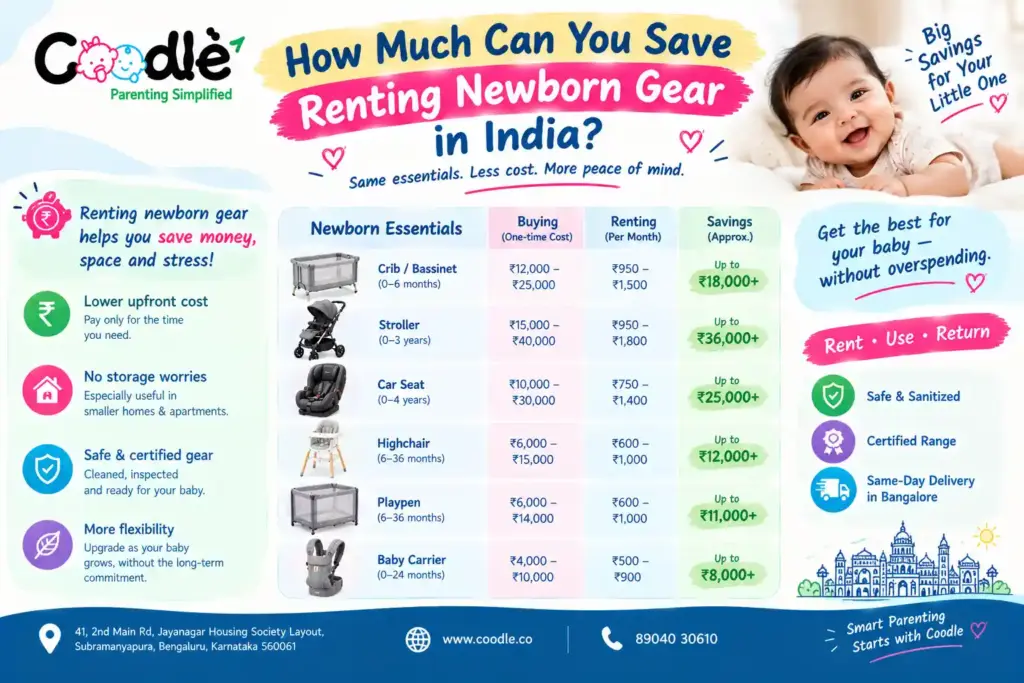
Let’s put real numbers to it. Here is what buying the three major newborn items new would cost versus renting them for the newborn stage:
Item | Buy New (approx.) | Rent for Newborn Stage |
|---|---|---|
Crib / bassinet | ₹8,000 – ₹15,000 | From ₹850/month |
Infant car seat | ₹7,000 – ₹25,000 | From ₹900/month |
Newborn-suitable stroller | ₹15,000 – ₹45,000 | From ₹900/month |
Total (buy vs 4-month rent) | ₹30,000 – ₹85,000 | ≈ ₹10,600 for 4 months |
Renting the three big items for the newborn stage costs a fraction of buying them — and when your baby outgrows the newborn setup, you simply return or swap the gear rather than trying to sell it or finding storage space in a compact Indian apartment.
What About Hygiene? Is Rented Newborn Gear Safe?
This is the most common and most important question new parents ask, and it deserves a direct answer. A newborn has the most sensitive immune system of any stage, so hygiene is paramount. Rented gear from a certified provider like Coodlè is cleaned to a hospital-grade standard before every rental — a 15-point inspection and sanitisation process that covers frame disinfection, machine-washed fabric at 60°C, and UV sanitisation of soft components.
In practice, a professionally cleaned rented crib or car seat is often cleaner than a brand-new product that has passed through multiple hands in packaging, shipping, and store display. For a deeper look at how this works, see the linked guide on whether pre-owned baby gear is safe for newborns.
A Simple Newborn Setup Timeline for Indian Parents
✦ Before birth (last month of pregnancy): Arrange the crib/bassinet and the infant car seat. These are needed from day one — the car seat for the hospital-discharge drive, the crib for the first night home.
✦ First 2 weeks: Focus on feeding and sleep. You will use very little gear beyond the sleep surface, feeding supplies, and nappies.
✦ Weeks 3–8: Introduce the stroller or carrier for short walks. Fresh air and gentle movement help both baby and parents.
✦ Around 3 months: Start thinking about the next stage. As your baby approaches sitting and, later, solids, you will move toward highchair and playpen needs — covered in the linked 6-month gear guide.
A Simple Newborn Setup Timeline for Indian Parents
What baby gear do I actually need for a newborn in India?
Lorem ipsum dolor sit amet, consectetur adipiscing elit. Ut elit tellus, luctus nec ullamcorper mattis, pulvinar dapibus leo.
Is it better to rent or buy baby gear for the first 3 months?
For the first three months, renting is almost always better for the large items — crib, car seat, and stroller — because a newborn uses them for only a few weeks to months before outgrowing them. Buying these new means paying full price for something used briefly. Small personal items like feeding supplies, clothing, and changing consumables should be bought.
How much does newborn baby gear cost in India in 2026?
Buying the three major newborn items new (crib, car seat, stroller) costs roughly ₹30,000–₹85,000. Renting the same three items for a typical 4-month newborn stage costs approximately ₹10,600 total. Small personal items (clothing, feeding, nappies) add a few thousand rupees regardless of the rent-versus-buy choice.
Is a rented crib or car seat safe and hygienic for a newborn?
Yes, when rented from a certified provider that follows a proper hygiene process. Reputable rental services clean every item to a hospital-grade standard — frame disinfection, machine-washed fabric at 60°C, and UV sanitisation — before each rental, plus a full safety inspection. This is often cleaner than a new product that has passed through packaging and store handling.
What baby products are a waste of money for newborns?
For newborns, the most common wasted purchases are bottle warmers (warm water works), wipe warmers, dedicated steriliser machines (boiling water sterilises), elaborate outfit sets, newborn shoes, and any product bought new that will be used for only a few weeks. Wheeled baby walkers should be skipped entirely at every stage.
Do I need a stroller for a newborn or is a carrier enough?
Either works, and it depends on your lifestyle and your baby’s preference. A stroller with a fully flat recline is suitable from birth and is useful for walks and errands. A soft newborn-safe carrier keeps the baby close and frees your hands. Because preference varies so much, renting a stroller first — rather than buying one — lets you discover what works before committing to a large purchase.
What is the safest way for a newborn to sleep in India?
A newborn should sleep alone, on their back, on a firm flat surface with a fitted sheet only — no pillows, bumpers, quilts, or soft toys. A crib, bassinet, or bedside co-sleeper in the parents’ room for the first six months is widely recommended. Traditional hanging cradles (jhoola) are best kept for supervised soothing rather than unsupervised overnight sleep.
When should I buy or arrange baby gear before the baby arrives?
Arrange the sleep surface (crib/bassinet) and the infant car seat in the last month of pregnancy, since both are needed from day one — the car seat for the hospital-discharge journey and the crib for the first night home. The stroller and other items can be arranged in the first few weeks once you understand your baby’s routine.
Can I rent baby gear for a newborn in Bangalore and get same-day delivery?
Yes. Coodlè offers same-day delivery across Bangalore for orders placed before noon, including cribs, infant car seats, and newborn-suitable strollers. All items are hygiene-certified before delivery, which is especially reassuring for the newborn stage.
What is the minimum baby gear checklist for a first-time parent on a budget?
The minimum budget checklist is: a rented crib or bassinet, a rented infant car seat, a handful of bottles and muslin cloths, 6–8 soft cotton clothes, swaddle cloths, a changing mat with nappies and wipes, and either a rented stroller or an affordable carrier. This covers every genuine newborn need while keeping costs low by renting the big items instead of buying them.
The Bottom Line for New Parents in India
The newborn stage does not require a warehouse of baby gear. It requires six things done well: safe sleep, safe travel, feeding, clothing, changing, and a way to carry or wheel your baby. Get those right, rent the big items so you are not overpaying for gear used only briefly, and skip the gadgets that solve problems newborns do not have.
As your baby grows past three months and starts sitting and, later, eating solids, your gear needs will evolve — and you can adapt your rentals to match. Start simple, spend wisely, and enjoy those first precious months.