
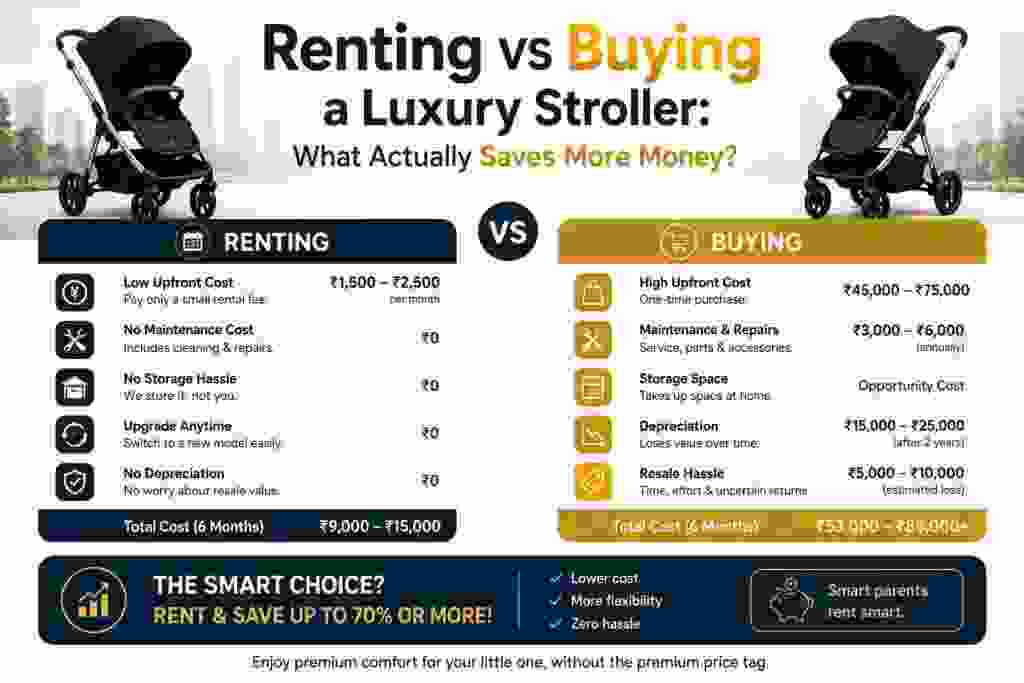
For most parents, renting a luxury stroller saves more money for short-term use, while buying becomes more cost-effective for daily use over several years. The real deciding factor is not the stroller brand — it’s how often you’ll actually use it.
Luxury strollers today are built for far more than smooth mall floors. Parents need them to handle potholes, uneven sidewalks, airport travel, crowded markets, and long daily walks without constantly jolting the baby. But with premium models carrying high price tags, many families now question whether ownership is even necessary.
For vacations, travel, or testing different models, renting through platforms like Coodlè can be a smarter financial move because it gives access to premium gear without the full upfront investment. On the other hand, families using a stroller almost every day often save more by buying, especially since luxury strollers retain strong resale value over time.
Here’s a detailed breakdown of where the money actually goes, the hidden costs most parents overlook, and which option truly delivers better long-term value.
Quick Comparison: Renting vs Buying a Luxury Stroller
| Scenario | Better Option | Why It Makes Financial Sense |
| One vacation or short trip | Rent | Lower upfront cost and no airline transport hassle |
| Trying a stroller before purchase | Rent | Avoids expensive buyer’s remorse |
| Daily use for 2–4 years | Buy | Lower long-term ownership cost |
| Small apartment with limited storage | Rent | No long-term clutter |
| Parents planning multiple children | Buy | Reuse increases value dramatically |
| Frequent flyers | Rent at destination | Avoids gate-check damage and baggage fees |
| Tight short-term budget | Rent | Smaller immediate financial commitment |
| Value-focused buyers | Buy used | Best balance of cost and resale value |
The Real Financial Question: Cost vs Cost of Ownership
Most people compare rental fees to purchase prices directly, but that is the wrong calculation.
The smarter comparison is:
- Rental Cost = Total amount paid during usage period
- Ownership Cost = Purchase Price – Resale Value
That difference changes everything.
A ₹90,000 luxury stroller that resells for ₹50,000 after three years does not really “cost” ₹90,000. The actual ownership expense is closer to ₹40,000, especially for premium brands with strong resale demand.
Meanwhile, renting a high-end stroller for ₹5,000–₹10,000 per week may seem affordable initially, but repeated rentals over several years quietly become more expensive than ownership.
This is why many financial planners now refer to luxury strollers as “temporary parenting assets” rather than simple purchases.
When Renting a Luxury Stroller Saves More Money
Renting works best when the stroller solves a temporary problem rather than becoming part of your daily routine.
For example, parents traveling to another city often realize how stressful airport logistics become with bulky baby gear. Carrying a large stroller through security, checking it at the gate, and hoping it survives baggage handling can turn a vacation into unnecessary chaos.
In those cases, renting via Coodlè at the destination becomes a strategic convenience rather than just a budget decision.
Instead of transporting a ₹1 lakh stroller through airports, you simply collect a clean, ready-to-use model when you arrive.
Renting Makes Sense For:
1. Short Vacations and Weekend Trips
If you only need a stroller for 5–10 days, buying one rarely makes financial sense.
A luxury stroller designed for smooth maneuverability and impact absorption on uneven roads can cost upwards of ₹70,000. Renting the same experience for a week costs a fraction of that amount.
Parents also avoid:
- Oversized baggage fees
- Airline damage risks
- Cleaning after travel
- Storage after the trip
This is particularly useful for destination weddings, family vacations, or temporary stays with relatives.
2. Testing Premium Models Before Buying
Luxury strollers look impressive online, but real-world usability matters more than aesthetics.
Some models feel too bulky in compact elevators. Others struggle on broken sidewalks or become difficult to fold while holding shopping bags and a baby simultaneously.
Renting first allows parents to test:
- Suspension on local roads
- Folding speed during cab rides
- Boot compatibility with their car
- Maneuverability in crowded markets
- Fabric durability in dusty environments
That practical testing often prevents expensive buying mistakes.
3. Families Living in Smaller Apartments
Urban parents increasingly prioritize space efficiency.
A full-size luxury stroller can dominate apartment hallways, car trunks, and storage corners. For families already managing cribs, toys, feeding chairs, and baby supplies, reducing clutter becomes valuable.
Renting solves the “where do we keep this after six months?” problem completely.
4. Parents Who Want Flexibility
Babies outgrow gear quickly. A stroller that feels perfect for a newborn may become inconvenient once the child becomes heavier and more active.
Rental services allow parents to switch between lightweight travel strollers, jogging systems, and compact urban models depending on changing needs.
That flexibility is difficult to replicate through ownership alone.
When Buying a Luxury Stroller Saves More Money
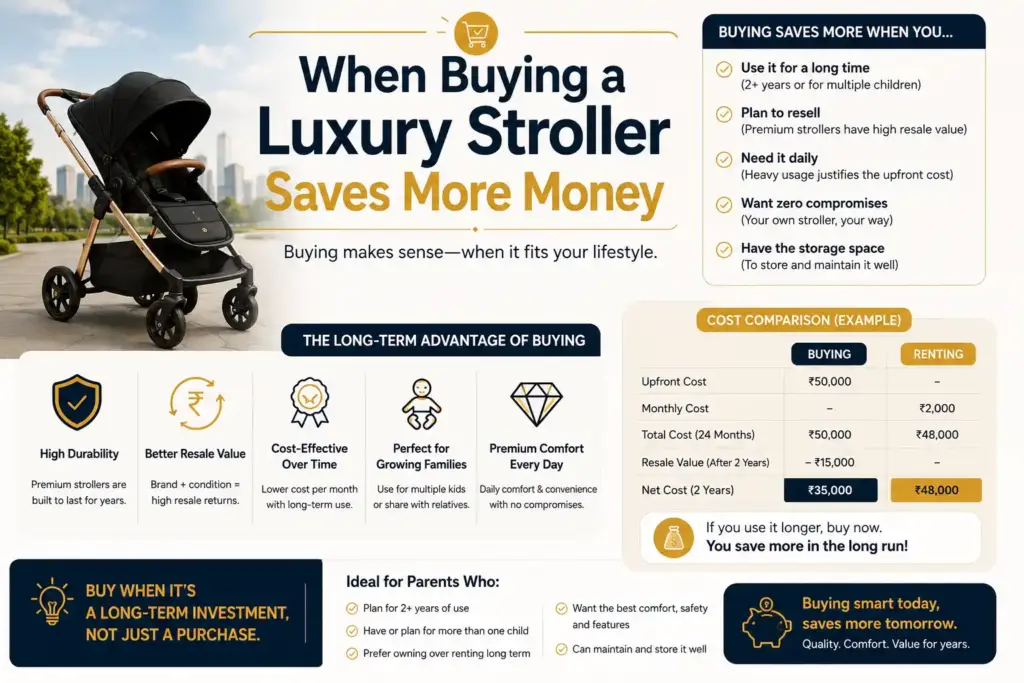
If the stroller becomes part of your daily lifestyle, ownership usually wins financially.
This is especially true in cities where parents walk frequently, visit parks regularly, or rely on strollers during everyday errands.
Repeated rental payments eventually exceed the net ownership cost.
Buying Makes More Sense For:
1. Daily Urban Use
If you use a stroller every day for school pickups, grocery runs, parks, or evening walks, renting quickly becomes inefficient.
A monthly rental may initially feel manageable, but over three years, the cumulative cost often surpasses the purchase price of a quality stroller.
Daily users also benefit from familiarity. You learn exactly how the stroller folds, how it handles speed breakers, and how it reacts on rough sidewalks.
That comfort matters more than most parents expect.
2. Families Planning Multiple Children
This is where buying becomes extremely cost-effective.
A premium stroller used for two children over five years dramatically lowers the per-child ownership cost. Durable brands are specifically engineered for long-term usage cycles, which is why many luxury models maintain excellent resale value even after years of use.
3. Parents Concerned About Hygiene Control
Rental companies maintain sanitation standards, but some parents still prefer full control over cleaning and maintenance.
Ownership eliminates concerns about:
- Previous wear and tear
- Hidden frame stress
- Fabric hygiene
- Missing accessories
- Cleaning penalties after spills
This becomes particularly important for newborns or babies with sensitive skin.
4. Long-Term Financial Efficiency
Luxury strollers depreciate differently from budget models.
Premium brands often retain 50–60% of their value because of:
- Better frame durability
- Strong wheel systems
- Higher suspension quality
- Replaceable parts
- Trusted safety certifications
That resale strength changes the economics entirely.
The Hidden Costs Most Parents Forget
The biggest mistake in stroller comparisons is ignoring “friction costs” — the small logistical problems that quietly affect real-world value.
Here are the hidden costs that matter.
Hidden Rental Costs
Delivery and Pickup Fees
Some rental services charge separately for transportation, especially during peak seasons.
Cleaning Penalties
Milk spills, food stains, or accidental damage may trigger additional cleaning fees.
Availability Problems
Popular premium models may already be booked during holidays or wedding seasons.
Repeated Rentals
Frequent short-term rentals eventually become financially inefficient.
Hidden Buying Costs
Storage Burden
Large strollers occupy valuable home space long after usage declines.
Maintenance
Wheel replacements, fabric cleaning, and brake repairs add long-term costs.
Depreciation Risk
Not all brands hold value equally well.
Airline Damage
Frequent travelers risk expensive frame damage during flights.
Why Indian Road Conditions Change the Decision
Most international stroller reviews are written for smooth sidewalks and organized urban infrastructure. Indian conditions are different.
Parents here deal with:
- Uneven paver blocks
- Sudden potholes
- Broken footpaths
- Gravel-heavy parks
- High speed breakers
- Dust accumulation
- Monsoon slush
That means stroller quality matters more than branding alone.
A premium stroller with proper suspension and vibration dampening protects the baby from constant jolting. Larger wheels and stable chassis systems also reduce wrist fatigue for parents during longer walks.
This is one reason many families prefer renting premium models through Coodlè before buying. Testing a stroller on your actual neighborhood roads reveals far more than showroom demonstrations ever will.
The Luxury Stroller “Break-Even Point” Most Parents Miss
Simple rule: If you need a stroller for everyday use beyond 6 months, buying usually becomes cheaper than renting. If your usage is occasional, travel-focused, or temporary, renting is typically the smarter financial move.
The reason is simple: repeated rental fees add up faster than most parents expect, especially for premium stroller models. Meanwhile, luxury strollers often retain strong resale value, which lowers the actual long-term ownership cost.
| Usage Pattern | Smarter Choice |
| Vacation or short-term use under 1 month | Rent |
| Occasional weekend use | Rent |
| Daily use for 6+ months | Buy |
| Planning for multiple children | Buy |
| Frequent flights or destination travel | Rent at destination |
| Testing a premium model before committing | Rent |
In reality, many families hit this “break-even point” within the first year itself, particularly when the stroller becomes part of everyday routines like walks, errands, daycare runs, or travel within the city.
A Smarter Alternative: Buying Used Luxury Strollers
There is also a middle ground many parents overlook.
Buying a 1–2 year-old luxury stroller often delivers the best financial outcome overall.
Why?
Because the steepest depreciation has already happened.
A stroller originally priced at ₹1 lakh may now cost ₹55,000–₹60,000 while still retaining excellent functionality. If maintained well, it may later resell again for a similar amount.
One important detail many parents overlook is that luxury stroller warranties are often non-transferable. If you buy a secondhand model, repairs for wheel systems, folding mechanisms, or frame issues may no longer be covered by the manufacturer, which can increase long-term maintenance costs.
That dramatically lowers total ownership cost.
This “secondhand sweet spot” is one of the strongest financial arguments against long-term renting.
The Sustainability Factor Parents Now Care About
Modern parenting decisions increasingly include environmental impact.
Luxury baby gear requires significant manufacturing resources, packaging, transportation, and plastic usage. Renting supports a more circular economy where high-quality products remain in active use rather than sitting unused in storage rooms.
For many urban families, renting through services like Coodlè aligns with both practical budgeting and sustainability goals.
It reduces waste without sacrificing comfort or safety.
Final Decision Matrix: Should You Rent or Buy?
Before deciding, ask yourself these three questions:
1. How often will you realistically use the stroller?
Occasional use favors renting. Daily use favors ownership.
2. Do you have enough storage space?:
Small apartments often make renting more practical.
3. Are you optimizing for convenience or long-term value?
Renting offers flexibility. Buying offers stronger financial efficiency over time.
Final Verdict
If your stroller needs are temporary — vacations, short stays, occasional outings, or testing premium models — renting is usually the smarter financial choice. It lowers upfront costs, removes storage headaches, and gives access to luxury engineering without major commitment.
But if you expect daily usage for more than six months, especially across multiple years or children, buying almost always creates better long-term value. The combination of durability, resale value, and familiarity typically outweighs recurring rental fees.
For many modern parents, the smartest approach is actually hybrid: rent first through Coodlè to test what works in real-life conditions, then buy only when you know the stroller truly fits your lifestyle, roads, and daily routine.
FAQs
It can be, especially if you walk daily or rely heavily on a stroller outdoors. Premium models usually offer better suspension, smoother steering, and stronger frames that handle long-term use more comfortably.
Most premium strollers are designed with higher-grade wheels, fabrics, and chassis systems that withstand years of regular use. Many parents continue using them for second children without major performance issues.
Always inspect the wheel condition, brake responsiveness, harness quality, and fabric cleanliness before accepting delivery. It also helps to confirm the replacement policy in case the stroller arrives damaged.
For frequent cab rides, elevators, and compact apartments, lightweight models are often easier to manage. However, they may not absorb road vibration as effectively as heavier all-terrain strollers on rough surfaces.
Yes, and that is one of the biggest advantages of rental platforms like Coodlè. Testing a stroller in real conditions — from narrow sidewalks to car boot storage — gives parents far more clarity than showroom demos or online reviews.