
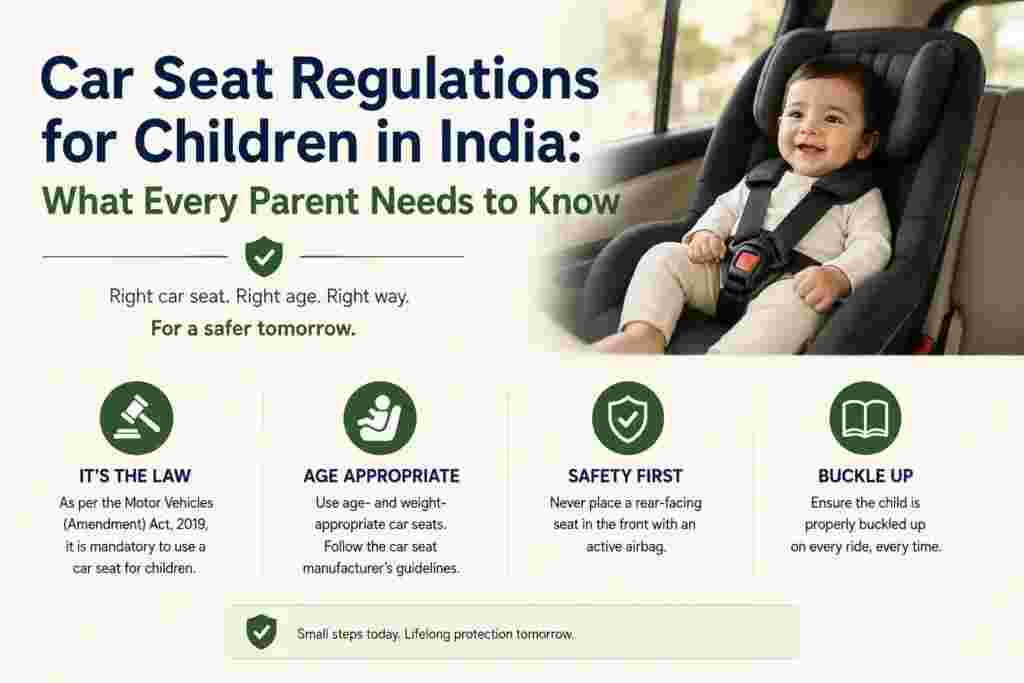
Children under 135 cm in height in India are required to travel using an age- and weight-appropriate child restraint system and should not sit in the front passenger seat. Depending on your child’s age, weight, and height, this could mean using a rear-facing infant seat, a forward-facing car seat, or a booster seat to ensure proper protection during travel.
Despite these guidelines, many Indian parents still rely on holding a child on their lap or allowing them to sit unrestrained in the back seat. While this may seem convenient for short journeys, it can become extremely dangerous during sudden braking, sharp turns, or accidents. Understanding the latest regulations, safety standards, and practical considerations can help you make informed decisions and keep your child safer every time you get behind the wheel.
What Is the Car Seat Law in India?
Under Section 194B of the Motor Vehicles (Amendment) Act, 2019, child safety while travelling in a vehicle is no longer just a recommendation—it is increasingly becoming a legal responsibility.
Current guidelines require children below 135 cm in height (approximately up to 12 years of age) to use an appropriate child restraint system. In addition, children under this height should not occupy the front passenger seat. Instead, they should be secured in the rear seats using a suitable child safety seat based on their age, weight, and developmental stage.
Failure to comply may attract penalties, including fines (₹1000) under applicable motor vehicle regulations.
More importantly, these regulations are designed to address a critical reality: adult seat belts are engineered for adult bodies, not children. An adult seat belt that fits correctly can sit dangerously across a child’s neck or abdomen, increasing injury risk during a collision.
Why Child Car Seats Matter More Than Most Parents Realise
Many parents assume that holding a child tightly is enough during travel. Unfortunately, physics works against even the strongest adult during a sudden impact.
During a collision, the force generated can multiply a child’s body weight several times over in a fraction of a second. This makes it virtually impossible to securely hold a child in place.
Children also have unique anatomical characteristics:
- Their heads are proportionally larger than those of adults.
- Their neck muscles are still developing.
- Their spine and skeletal structure are more vulnerable to impact forces.
- Standard seat belts are not designed around the body proportions.
This is why child restraint systems are categorised according to specific weight and age groups rather than using a one-size-fits-all approach.
Child Car Seat Requirements by Age and Weight
Choosing the right seat starts with understanding where your child falls within the recommended categories.
| Child’s Age & Weight | Recommended Seat Type | Key Safety Purpose |
| 0 to 15 Months (Up to 13 kg) | Rear-Facing Infant Seat | Protects the neck, head, and spine during impact |
| 15 Months to 4 Years (9–18 kg) | Forward-Facing or Convertible Seat | Provides secure restraint through a 5-point harness |
| 4 to 12 Years (15–36 kg) | Booster Seat | Positions the vehicle seat belt correctly across the chest and thighs |
While age serves as a useful guideline, weight and height should always take priority when selecting a car seat.
Why Rear-Facing Seats Are So Important for Infants
One of the most misunderstood aspects of child safety is the requirement for rear-facing travel during infancy.
An infant’s neck muscles are not yet strong enough to withstand the forces generated during sudden braking or collisions. A rear-facing seat distributes crash forces across the back, neck, and head rather than concentrating them on the spine.
For this reason, infants should remain in a rear-facing seat until they exceed the manufacturer’s specified weight or height limits.
This isn’t merely a regulatory recommendation. It is based on decades of crash-testing data and child biomechanics research.
When Should You Switch to a Forward-Facing Seat?
As your child grows, a forward-facing seat equipped with a 5-point harness becomes appropriate.
The harness is designed to spread impact forces across the strongest parts of the child’s body, including the shoulders, hips, and upper torso. Compared to a regular seat belt, a properly adjusted 5-point harness offers significantly better restraint for younger children.
Many parents transition too early because their child appears uncomfortable or because their legs begin touching the seatback. However, safety experts consistently advise following the seat manufacturer’s limits rather than switching based solely on appearance.
Understanding Booster Seats
Booster seats are often overlooked because older children appear capable of using standard seat belts.
The reality is different.
Without a booster seat, the vehicle’s seat belt may rest across the abdomen and neck instead of the pelvis and chest. During a crash, this poor positioning can contribute to serious injuries.
A booster seat elevates your child so that:
- The shoulder belt crosses the centre of the chest.
- The lap belt rests across the upper thighs.
- The belt remains correctly positioned throughout the journey.
Children should continue using a booster seat until they are approximately 135 cm tall or meet the vehicle and safety seat manufacturer’s recommendations.
Where Should a Child Sit in the Car?
One of the most important regulations is also one of the simplest. Children under 135 cm should always travel in the rear seats whenever possible.
The back seat offers greater protection from frontal impacts, which are among the most common and severe types of crashes.
If a child must travel in the front passenger seat due to unavoidable circumstances:
- Move the seat as far back as possible.
- Follow vehicle manufacturer recommendations.
- Ensure the child restraint system is compatible with the seating position.
However, the rear seat should remain the default choice for child passengers.
What Is ISOFIX and Why Does It Matter?
Many modern vehicles sold in India come equipped with ISOFIX anchor points.
ISOFIX is an internationally standardized system that allows child car seats to attach directly to fixed anchors in the vehicle instead of relying solely on seat belts.
Under Indian regulations, vehicles manufactured after April 2015 are required to include child restraint anchorages, making installation easier and more secure.
The benefits of ISOFIX include:
- Faster installation
- Reduced installation errors
- Improved seat stability
- Greater peace of mind for parents
When shopping for a child seat, checking for ISOFIX compatibility can simplify installation significantly.
How to Choose a Safe Child Car Seat
Not all child seats offer the same level of protection.
When evaluating options, look for seats that meet recognized safety standards such as:
- ECE R44/04
- ECE R129 (i-Size)
- Other internationally recognized crash-testing certifications
Beyond certifications, consider:
- Proper fit for your child’s size
- Vehicle compatibility
- Ease of installation
- Harness adjustability
- Side-impact protection features
- Condition and maintenance history
A well-fitted seat installed correctly is often safer than an expensive seat installed improperly.
The Challenge Most Indian Parents Face
While child safety is non-negotiable, practicality matters too.
A quality crash-tested car seat can cost anywhere between ₹8,000 and ₹25,000 or more. The challenge is that children quickly outgrow one category and move into the next.
Many families find themselves purchasing multiple seats over a relatively short period:
- Infant seat
- Toddler seat
- Booster seat
At the same time, perfectly usable seats often remain unused in homes once a child outgrows them.
This creates an unnecessary financial burden while also contributing to waste.
Why More Parents Are Choosing Coodlè for Second-Hand Car Seats
This is where we believe a smarter approach makes sense.
At Coodlè, we help parents buy or rent quality second-hand car seats without compromising on safety, convenience, or affordability. Instead of investing heavily in equipment that may only be used for a limited period, you can access trusted child safety products at a fraction of the cost of buying new.
What makes Coodlè different is our focus on trust and practicality.
Carefully Verified Options
We understand that parents are naturally cautious about pre-owned child safety equipment. That’s why every listed car seat undergoes careful evaluation so families can make informed decisions with confidence.
Significant Cost Savings
Children grow quickly, but that doesn’t mean your expenses have to grow at the same pace. Through Coodlè, you can access premium child car seats at much lower prices compared to buying brand-new models.
Flexible Rental Solutions
Not every family needs a permanent car seat.
If you are visiting India, planning a road trip, expecting relatives with children, or simply need a seat for a short duration, renting can be a practical and cost-effective alternative. We make that possible through flexible rental options.
A Sustainable Parenting Choice
Choosing pre-owned baby gear helps extend the life of products that are still perfectly usable. It reduces waste and supports a more sustainable approach to parenting without compromising safety standards.
How We Prioritise Safety at Coodlè
We understand that when it comes to child safety equipment, trust matters just as much as affordability. That’s why safety is at the centre of our evaluation process before a car seat is made available on our platform.
Every car seat goes through a careful condition assessment, including checks for visible structural damage, missing components, harness functionality, buckle operation, and overall usability. We also verify the product’s history wherever possible and only accept seats that meet our quality and safety criteria. Combined with thorough cleaning and sanitisation, this process helps give parents greater confidence when choosing a pre-owned car seat through Coodlè.
What parents can trust:
- Careful condition and functionality checks
- Verification of essential safety components
- Thorough cleaning and sanitisation process
- Transparent product information
- Affordable access to quality child safety gear
Final Thoughts
The biggest mistake many parents make is waiting until a long road trip or a new traffic rule to think about child passenger safety. The right car seat should be part of everyday travel, whether you’re driving across the city, dropping your child at school, or heading out on a family vacation.
The good news is that keeping your child safe doesn’t always require spending a fortune on brand-new equipment. At Coodlè, we help families buy or rent quality pre-owned car seats that fit their needs, budget, and stage of parenting—making safer travel more accessible for every journey ahead.
Frequently Asked Questions
Yes, provided it meets recognised international safety standards and can be installed correctly in your vehicle. Always check compatibility with your car’s seat dimensions and anchoring system before use.
A child has typically outgrown a seat when they exceed its height or weight limit, not simply because they look big for it. Always refer to the manufacturer’s specifications rather than age alone.
Most road accidents happen close to home during routine journeys. Even a short drive to school, a grocery store, or a nearby relative’s house carries risks that make proper restraint important.
Yes, but frequent transfers increase the chances of incorrect installation. If you regularly switch vehicles, double-check the fit and installation each time before travelling.
Look for a functioning harness, intact buckles, original labels, no visible cracks, and complete components. It’s also worth confirming the seat’s age and whether replacement parts are still available if needed.