Every parent considering baby gear rental has the same question — and it’s the right question: how do I know this stroller (or crib, or car seat) has been properly cleaned for my baby?
It’s a fair concern. Baby gear is in intimate contact with your baby for hours every day. A stroller harness that was used by a child with a stomach bug, a crib mattress that carries another baby’s sweat and shed skin cells, a highchair tray with food residue in the grooves — these are real possibilities in an unverified rental or second-hand purchase.
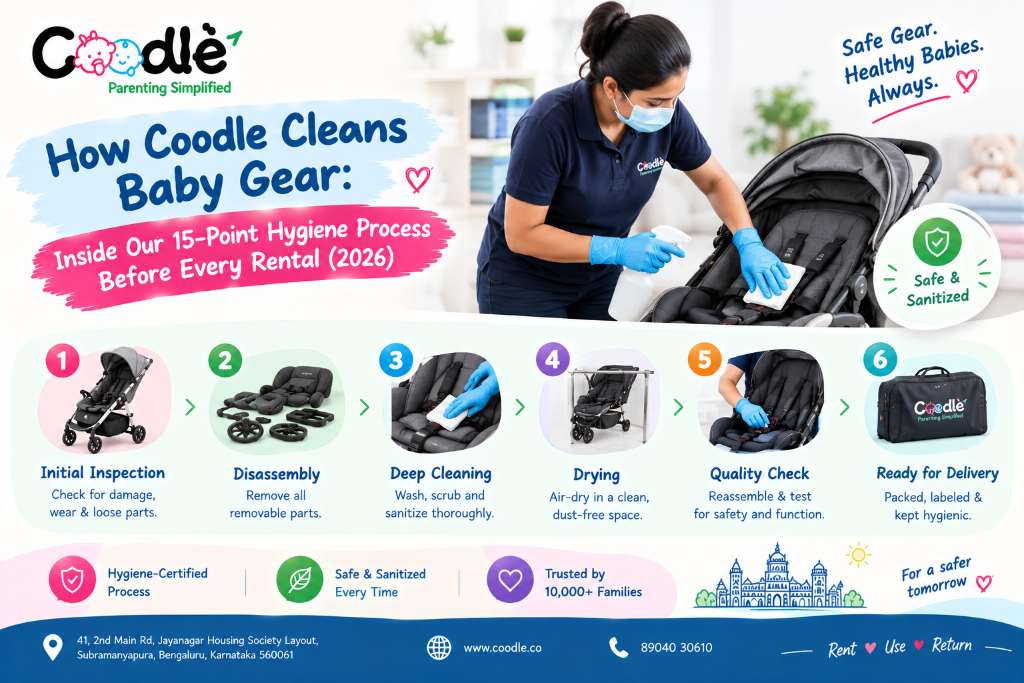
Coodlè‘s answer to this concern is our 15-point hygiene and safety process — a documented, repeatable, professionally executed cleaning and inspection protocol applied to every product before every rental. This guide opens the door completely: here is exactly what we do, why we do it, and what
Why Standard Cleaning Is Not Enough for Baby Gear
A cloth wipe with a surface cleaner will clean what’s visible. But baby gear accumulates contamination in places that standard cleaning doesn’t reach — and these are precisely the places most in contact with your baby:
✦ Stroller harness webbing: Fabric straps absorb organic material — food, sweat, saliva, skin cells — deep into the weave. Surface wiping has zero effect on contamination within the fibres.
✦ Highchair tray edge grooves: The junction between tray surface and tray rim, and the adjustment slots on the tray sides, trap food residue. A standard wipe goes across the surface — not into the groove.
✦ Crib mattress surface: A previous baby’s sleep-related residue — oils, sweat, saliva — penetrates mattress fabric covers within weeks of use. Surface wipes don’t reach the fabric’s inner layers.
✦ Car seat foam: Car seat foam beneath the cover fabric can absorb liquid that passes through cover seams. Odour is the indicator — an off smell from a car seat you can’t wipe away indicates foam contamination.
✦ Stroller canopy folds: The fold of the canopy — where it tucks away — creates a damp microenvironment where mould can establish in Bangalore’s humidity. Hidden from view and unreachable by standard cleaning.
Coodlè's 15-Point Hygiene and Safety Process: Step by Step
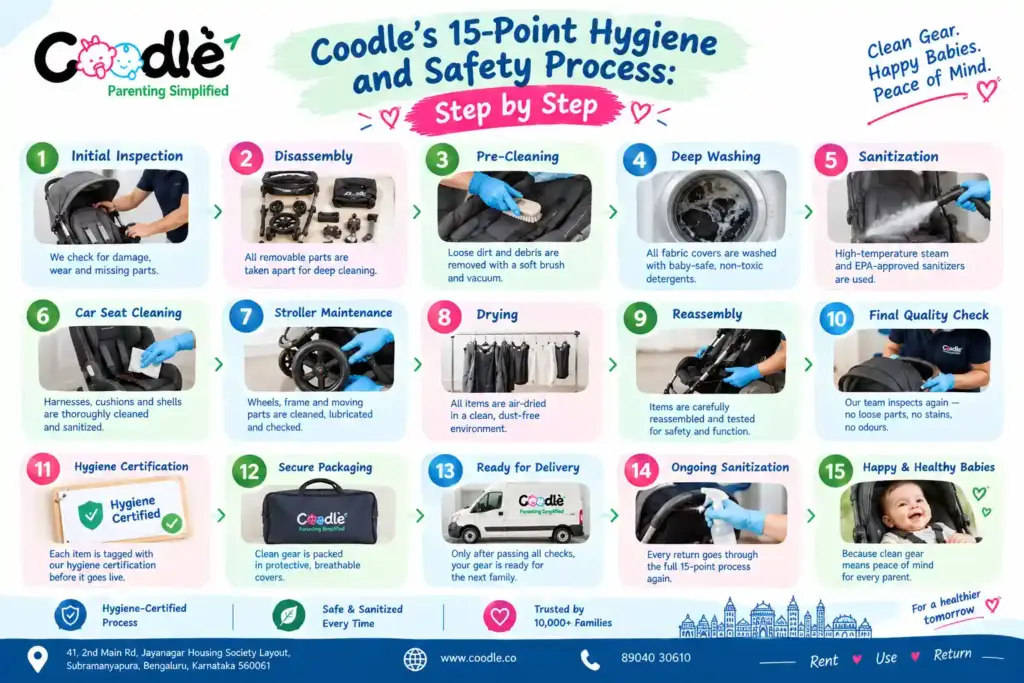
Points 1–4: Physical Safety Inspection
Cleaning a product that isn’t safe is pointless. Safety inspection comes first:
✦ Point 1 — Structural integrity: Every frame joint, tube, weld, and connection is examined under load. Hairline cracks, loose connections, and stress marks are identified.
✦ Point 2 — Mechanism function test: All mechanical functions tested: fold mechanisms (50+ cycles), recline adjustments, height adjustments, wheel swivel and lock, fold-flat locks.
✦ Point 3 — Harness system test: Buckle click and release force tested. Webbing examined full-length for fraying or thin spots. Adjuster function tested under load. Any harness component showing wear is replaced, not cleaned.
✦ Point 4 — Recall database check: Model and serial number checked against CPSC (USA), BEUC (EU), and BIS (India) recall databases. Any recalled product or recalled component results in the product being removed from the rental fleet.
Points 5–8: Disassembly and Component Sorting
Effective cleaning requires disassembly. Products are separated into components before cleaning:
✦ Point 5 — Fabric removal: All removable fabric components are detached from the frame: seat covers, harness straps, canopy panels, liner inserts, tray pads.
✦ Point 6 — Hardware inspection: With fabric removed, all hardware is inspected for rust, corrosion, and mechanical wear that fabric conceals.
✦ Point 7 — Component sorting: Fabric components sorted by material type (machine-washable, hand-wash only, dry-clean only). Hard components sorted for appropriate cleaning method.
✦ Point 8 — Damaged component identification: Any component that will be replaced rather than cleaned is identified and set aside. Replacement sourcing is initiated if needed.
Points 9–11: The Cleaning Process
With components separated, cleaning is targeted and thorough:
✦ Point 9 — Machine washing (fabric): All machine-washable fabric components — harness straps, seat covers, liner inserts, canopy panels — washed at 60°C with baby-safe, fragrance-free detergent. 60°C is the temperature required to kill most pathogenic bacteria including Staphylococcus aureus and E. coli.
✦ Point 10 — Frame surface disinfection: All hard surfaces (frame tubing, tray surfaces, wheel rims, buckle hardware) disinfected with a hospital-grade, baby-safe, non-toxic surface disinfectant. Contact time (the dwell time required for the disinfectant to be effective) is observed before wiping — typically 5 minutes. This is not a spray-and-wipe process.
✦ Point 11 — Deep groove and crevice cleaning: Specific areas identified as food traps, fluid collection points, or mould-risk zones are cleaned with small brushes and the same disinfectant solution. This includes highchair tray grooves, stroller fold joints, car seat belt guides, and any crevice accessible to liquid during use.
Points 12–13: UV Sanitization and Drying
✦ Point 12 — UV sanitization: After machine washing, all fabric components undergo UV-C light treatment. UV-C radiation damages the DNA of microorganisms — bacteria, viruses, and mould spores — that survive the washing process. UV treatment is particularly effective against pathogens that are resistant to detergent washing.
✦ Point 13 — Complete drying: All components are fully dried before reassembly. Residual moisture in fabric components creates conditions for mould growth in storage. Fabric components are machine-dried or air-dried in a controlled environment, verified dry before proceeding to reassembly.
Points 14–15: Reassembly, Final Check, and Sealed Packaging
✦ Point 14 — Reassembly and function retest: All components are reassembled and all mechanical functions retested after reassembly. Any function that tests differently post-reassembly triggers re-disassembly and investigation. The post-clean product must perform identically to the pre-clean standard.
✦ Point 15 — Quality sign-off and sealed packaging: A senior technician performs a final visual and tactile inspection, confirms the cleaning documentation, and approves the product for rental. The product is then sealed in protective packaging to maintain the cleaned state through storage and delivery.
Product-Specific Cleaning Highlights
Strollers
Strollers have the most components to clean and the most complex disassembly. Coodlè’s stroller process specifically addresses the three highest-contamination points:
✦ Harness straps: Removed and machine-washed at 60°C. Not wiped. Washed.
✦ Canopy folds: Canopy removed from frame and washed flat — specifically targeting the fold area for mould.
✦ Wheel well areas: The areas where wheel hubs connect to the frame accumulate grit and organic matter. Cleaned with small brush and disinfectant.
Car Seats
Car seats carry the highest stakes of any baby product — and receive the most thorough cleaning:
✦ Cover removal: Most car seat covers are specifically designed to be removed without tools. Coodlè removes all covers for every rental and washes at 60°C.
✦ Foam inspection: Foam inserts are inspected for odour (indicating penetration of organic liquid) and replaced if any odour is detected.
✦ Harness routing channels: The channels through which harness webbing runs are cleaned with a narrow brush to remove accumulated debris.
✦ ISOFIX connectors: If present, ISOFIX connectors are cleaned and function-tested.
Baby Highchairs
Highchairs are the most food-contaminated product in the baby gear category:
✦ Tray soak: Trays are soaked in disinfectant solution for 20 minutes before scrubbing — allowing the solution to penetrate and dissolve food residue in grooves and slots.
✦ Harness wash: All harness straps removed and machine-washed.
✦ Crevice inspection: The junction between seat and frame is specifically examined for food accumulation after cleaning — a common location that a standard clean misses.
Baby Cribs
✦ Slat cleaning: Every slat is wiped individually with disinfectant and inspected for damage post-cleaning.
✦ Mattress cover wash: The mattress cover (where included) is removed and machine-washed at 60°C.
✦ Joint and hardware: All frame joints and adjustment hardware are cleaned and dried to prevent rust accumulation.
What Our Hygiene Process Does Not Include — Honesty Matters
We believe in complete transparency. Here is what our process does not guarantee:
✦ We cannot eliminate 100% of all microorganisms: No cleaning process achieves sterility outside a medical-grade autoclave. Our process reduces microbial load to safe levels — comparable to what you’d achieve washing your own baby’s gear at home following best practice.
✦ Foam core cleaning: If a product’s foam core (beneath removable covers) has become saturated with organic liquid, we replace the cover but cannot replace the foam in most products. Products with foam odour are removed from the fleet and replaced.
✦ Chemical-free guarantee: We use baby-safe, non-toxic cleaning agents — but ‘chemical-free’ cleaning is a marketing claim, not a possibility. Every cleaning process uses chemistry. Ours uses chemistry specifically chosen for infant safety.
Frequently Asked Questions — Coodlè's Hygiene Process
s rented baby gear from Coodlè safe for a newborn?
Yes. Our 15-point process is specifically designed for products used by newborns, who have the most sensitive immune systems and spend the most time in contact with the gear. The process exceeds what most parents do with their own baby gear.
What cleaning agents does Coodlè use?
Baby-safe, non-toxic, fragrance-free surface disinfectants tested for use around infants. We do not use bleach, harsh solvents, or fragranced products on any baby gear.
How often is each product cleaned?
Every product is cleaned through the full 15-point process before every new rental — regardless of how recently it was last rented or cleaned. There is no ‘light clean for short gaps’ shortcut.
Can I see the cleaning documentation for my rental product?
Yes. Coodlè can provide a hygiene inspection summary for any rental on request. Contact +91-8904030610 or sales@coodle.co.
What happens if a product fails the safety inspection?
It is removed from the rental fleet. Depending on the nature of the failure — a broken buckle, a worn harness, a frame crack — the product is either repaired to standard before return to service, or permanently retired from the fleet.
Is Coodlè's hygiene process the same for both rental and pre-loved sale products?
Yes. Pre-loved sale products go through an identical hygiene and safety inspection before listing. The process is the same — the outcome is a sale product rather than a rental product.
The Standard Your Baby Deserves
The question isn’t whether rented baby gear can be safe. The question is whether the rental service you choose has the process to make it safe. Coodlè‘s answer is the 15-point protocol described above — documented, consistent, and applied to every product before every rental, every time.
This is the hygiene standard your baby deserves. And it’s the standard Coodlè delivers.