
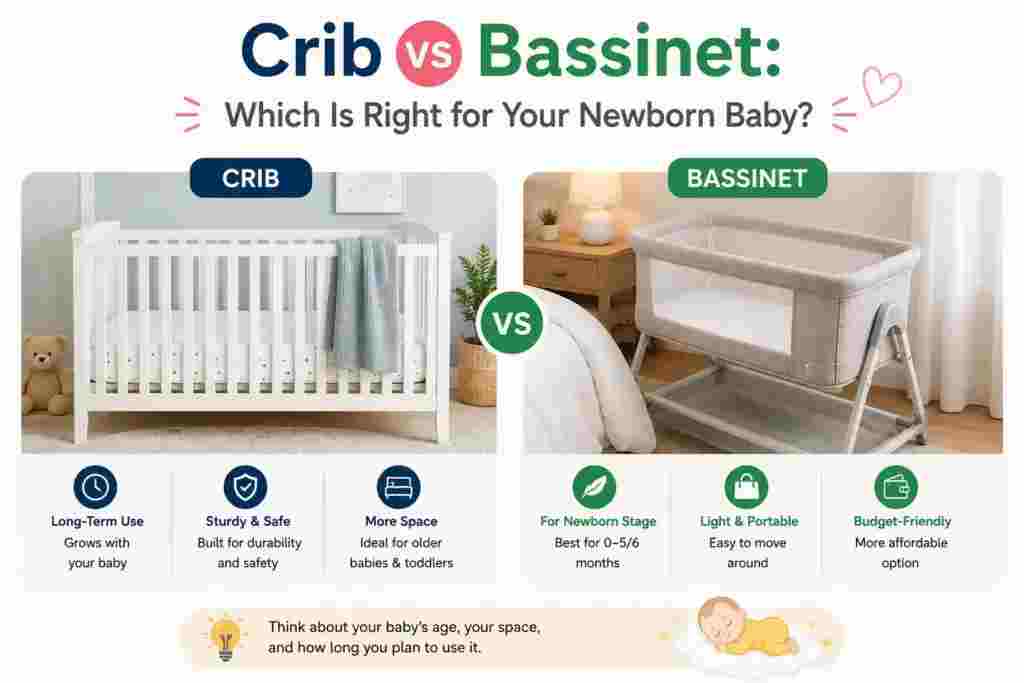
Bringing your newborn home comes with a lot of decisions, and one of the biggest is choosing where your baby will sleep. If you’re trying to decide between a crib and a bassinet, you’re not alone. Most parents consider factors like safety, comfort, available space, convenience, and budget before making a choice.
The simple answer is this: a bassinet is made for the first few months of your baby’s life and is designed to keep your newborn close by, while a crib is a larger, long-term sleeping solution that can be used for several years. Neither option is better for every family. The right choice depends on your home, your daily routine, your recovery after birth, and what works best for your budget.
What Is a Bassinet? Understanding the Newborn Sleep Solution
A bassinet is a small sleeping space designed for newborn babies. Most babies use a bassinet from birth until around 3 to 6 months, depending on their growth and development.
Compared to a crib, a bassinet is smaller, lighter, and usually placed next to the parents’ bed. This makes it especially helpful during the newborn stage when babies wake often for feeding and comfort.
Why Many Parents Choose a Bassinet
Easier nighttime care
Newborns often wake every few hours. Keeping your baby close makes feeding, soothing, and checking on them much easier during the night.
Helpful during recovery
For mothers recovering from a C-section or difficult delivery, bending over a crib can be uncomfortable. A bedside bassinet makes it easier and safer to lift your baby with less strain.
Great for room sharing
A bassinet fits easily beside your bed, even in smaller bedrooms. This makes room sharing more convenient during the first few months.
Comfortable for newborns
The smaller sleeping space can feel cosy and secure for newborns as they adjust to life outside the womb.
Limitations of a Bassinet
While bassinets are convenient, they are only a short-term solution.
Many parents focus on the weight limit, but mobility is what matters most. Once your baby starts rolling over, pushing up on their hands, or trying to sit up, it’s time to move them to a crib for safety.
For most babies, this transition happens between 3 and 5 months of age.
What Is a Crib? The Long-Term Sleep Investment
A crib is a full-sized baby bed designed to accommodate your child from infancy through the toddler years.
Unlike a bassinet, a crib offers significantly more space, stronger construction, and greater longevity. Many families use the same crib for two to three years or longer.
If a bassinet is designed for the newborn phase, a crib is designed for growth.
Why Parents Prefer Cribs
Long-term value
A quality crib can serve your child for years. Instead of purchasing multiple sleep solutions, you can invest once and use it throughout infancy and toddlerhood.
More room for movement
As babies grow, they become increasingly active during sleep. Rolling, stretching, scooting, and standing all require additional space.
A crib accommodates these developmental changes comfortably and safely.
Greater stability
Cribs are built with long-term use in mind. Their sturdy construction makes them highly stable, which becomes increasingly important as babies become more mobile.
Suitable from day one
Many parents assume cribs are only for older babies, but a crib can safely be used from birth. The primary consideration is whether the setup works practically for your family’s daily routine.
Potential Drawbacks of a Crib
The biggest challenge is space.
A crib occupies considerably more room than a bassinet, which can be difficult in compact apartments or shared bedrooms.
Cribs are also less portable. Once assembled, they generally remain in one location.
Crib vs Bassinet: At a Glance
The table below summarises the key differences.
Feature | Bassinet | Crib |
Recommended Age | Birth to 3–6 months | Birth to 3+ years |
Size | Compact | Larger |
Portability | High | Low |
Room Sharing | Excellent | Possible if space allows |
Longevity | Short-term | Long-term |
Cost Duration | Lower upfront cost | Better long-term value |
Growth Space | Limited | Extensive |
Mobility Support | Limited | Suitable for active babies |
The Hidden Reality Parents Often Discover Later
When comparing baby sleeping options, most articles talk about features and specifications. What they often don’t cover are the real-life challenges parents face after the baby arrives.
The Transition to a Crib
Many babies get used to sleeping in a small bassinet right next to their parents.
When it’s time to move them to a larger crib, sometimes in a different room, their sleep may be disturbed for a while. The new space and surroundings can take some getting used to.
Planning for this change early can help make the transition easier for both you and your baby.
The Cost of Buying Both
For many families, the ideal setup is simple:
- A bassinet for the first few months
- A crib, once the baby becomes more active and mobile
The challenge is that buying both brand-new can be expensive.
Since babies outgrow a bassinet so quickly, many parents feel they spent a lot on something that was only used for a few months. That’s why it’s worth thinking about your budget before deciding what to buy.
How to Decide Which One Is Right for You
There isn’t a universal answer. Instead, the best choice depends on your circumstances.
Choose a Bassinet If:
- You plan to room-share with your baby.
- Your bedroom has limited space.
- You want easier nighttime feeding access.
- You are recovering from childbirth and want to minimise bending.
- You value portability and flexibility.
Choose a Crib If:
- You want a long-term sleeping solution.
- You have enough space for a permanent setup.
- You prefer making a single purchase.
- You have a dedicated nursery.
- You want maximum value over several years.
Choose Both If:
- Your budget allows.
- You want the convenience of a bassinet initially.
- You plan to transition to a crib after a few months.
- You want the benefits of both sleep environmen
Should You Buy Both a Bassinet and a Crib?
For many families, buying both is the most practical solution from a convenience perspective.
A bassinet can simplify the newborn stage, while a crib becomes essential once your baby starts moving independently.
The challenge is financial efficiency.
Spending heavily on a product that may only be used for 12 to 16 weeks doesn’t always make sense—especially when raising a child already involves numerous expenses.
This is why many modern parents are exploring rental and pre-loved baby furniture options rather than purchasing everything brand new.
Looking for an Affordable Crib in Bangalore?
Once you’ve decided between a bassinet and a crib, the next thing to think about is cost.
A good crib is worth the investment, but that doesn’t mean you have to buy a brand-new one.
The reality is that babies use cribs for only a few years, while a well-maintained crib can stay in great condition for much longer. That’s why many parents today are choosing pre-loved or rental options instead of paying full retail prices.
This is where we at Coodlè help families make a practical and budget-friendly choice.
Why Parents in Bangalore Choose Coodlè

At Coodlè, we help parents access safe, affordable, and practical baby furniture solutions without the financial burden of purchasing everything new.
Buy Quality Second-Hand Cribs
We make it easier to find well-maintained, pre-loved cribs that offer excellent value while meeting safety expectations.
Instead of paying premium retail prices, you can invest in a quality crib at a more affordable cost.
Rent Baby Furniture for Short-Term Needs
Not every baby product needs to be owned. For items with a short usage window, renting can be a practical and budget-friendly option that helps families avoid unnecessary spending.
Safety Comes First
We understand that safety is the biggest concern when considering second-hand baby furniture. That’s why every crib undergoes careful inspection and quality checks before reaching another family.
Sustainable Parenting Choice
Choosing pre-loved baby furniture also reduces waste. Rather than allowing perfectly usable products to sit unused, families can extend their life cycle and contribute to a more sustainable approach to parenting.
Designed for Bangalore Families
From apartment living in Whitefield and HSR Layout to growing families across Indiranagar and other parts of Bangalore, parents often face space and budget constraints.
Our platform helps address those challenges by offering flexible alternatives to traditional retail purchases.
Final Thoughts
Choose a bassinet if you want your newborn close by during the first few months. Choose a crib if you want a safer, more spacious, and long-term sleep solution that grows with your child and offers better value over time.
If you’re looking for affordable, high-quality second-hand cribs in Bangalore, explore Coodlè’s trusted collection and find the perfect crib for your little one without paying the price of a brand-new one.
Frequently Asked Questions
Can a newborn sleep directly in a crib instead of a bassinet?
Yes. A crib is safe for a newborn from day one as long as it has a firm mattress and follows current safety standards. A bassinet is simply more convenient for many parents during the early months.
Do babies sleep better in a bassinet or a crib?
Every baby is different, but some newborns settle more easily in a bassinet because the smaller space feels cosy and familiar. As babies grow, many sleep more comfortably in a crib with extra room to move.
How do I know when my baby has outgrown the bassinet?
Don’t rely only on age or weight limits. If your baby starts rolling over, pushing up on their hands, or sitting up, it’s time to move them to a crib for safety.
Is it safe to buy a second-hand crib?
Yes, provided the crib is in good condition and meets modern safety standards. Always check for loose parts, damage, missing hardware, or signs of wear before using it.
What should I avoid putting inside a crib or bassinet?
Keep the sleeping area simple. Avoid pillows, blankets, stuffed toys, sleep positioners, and bumper pads, as they can increase the risk of sleep-related accidents.