
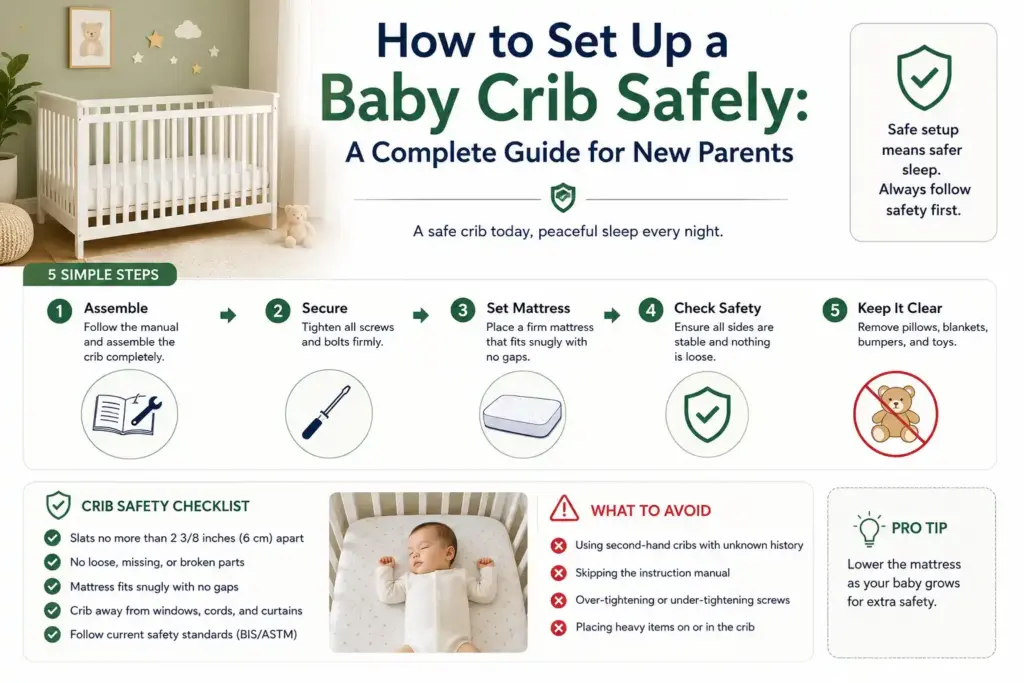
A safe baby crib requires three things: a properly assembled crib, a firm mattress that fits correctly, and a completely clutter-free sleep environment. Getting these fundamentals right can significantly reduce sleep-related risks and create a safer space for your baby to rest and grow.
Preparing for a new baby comes with countless decisions, but few are as important as creating a safe sleep environment. While many parents focus on nursery décor, themes, and accessories, the reality is that crib safety depends far more on proper setup than appearance. In fact, the safest crib often looks surprisingly simple.
From where you place the crib in the room to how you choose the mattress and adjust the mattress height over time, every detail plays a role in your baby’s safety. Small mistakes that seem harmless can create unnecessary risks, while a few simple checks can provide valuable peace of mind.
Why Crib Safety Matters More Than Nursery Design
A baby’s crib is where they will spend a significant portion of their first years sleeping, resting, and developing. Unlike many nursery items that are optional, a safe sleep environment directly affects your child’s well-being.
The American Academy of Paediatrics (AAP) continues to recommend that babies sleep on a firm, flat surface free from loose bedding, pillows, toys, and other soft objects. These recommendations are designed to reduce the risk of Sudden Infant Death Syndrome (SIDS), suffocation, entrapment, and other sleep-related injuries.
The truth is simple: a safe crib isn’t defined by how beautiful it looks. It’s defined by how effectively it protects your baby while they sleep.
Step 1: Assemble the Crib Exactly as Intended
Before placing a mattress or decorating the nursery, focus on proper assembly.
Many parents underestimate how important the manufacturer’s instructions are. Skipping a washer, using substitute screws, or assuming two similar-looking parts are interchangeable can compromise the crib’s structural integrity over time.
As you assemble the crib:
- Follow the manufacturer’s instructions step by step.
- Use only the hardware included with the crib.
- Tighten every screw, bolt, and bracket securely.
- Check that all locking mechanisms engage correctly.
- Ensure there is no wobbling, shifting, or creaking.
A useful test is to gently shake the assembled crib. The frame should feel solid and stable. If it rocks or moves noticeably, something needs adjustment before your baby uses it.
Structural Safety Benchmarks
Use the following measurements to verify that your crib meets essential safety standards.
| Safety Check | Recommended Standard | Why It Matters |
| Slat spacing | No more than 2⅜ inches (6 cm) apart | Prevents head entrapment |
| Mattress gap | No more than two fingers between the mattress and the frame | Prevents entrapment hazards |
| Frame stability | No wobbling or loose hardware | Prevents structural failure |
| Mattress surface | Firm and flat | Supports safe sleep |
One practical trick many parents find helpful is the “soda can test.” If a standard soda can can fit between the crib slats, the gaps are too wide, and the crib may not be safe for infant use.
Step 2: Choose the Right Location in the Nursery
Even the safest crib can become risky if it’s placed in the wrong area of the room.
When deciding where the crib should go, think beyond convenience and consider potential hazards that may not seem obvious at first glance.
Keep the Crib Away from Windows
Windows introduce several risks, including:
- Blind cords
- Curtain ties
- Drapery cords
- Drafts
- Direct sunlight
These hazards can become increasingly dangerous as babies begin standing and reaching.
Avoid Overhead Hazards
A crib should never sit beneath:
- Floating shelves
- Framed artwork
- Mirrors
- Wall-mounted décor
- Heavy decorative items
While these features may appear secure, anything positioned above a sleeping baby creates unnecessary risk.
Stay Clear of Electrical Hazards
Keep the crib away from:
- Electrical outlets
- Extension cords
- Baby monitor cables
- Charging cords
- Lamps with dangling wires
As mobility increases, babies become surprisingly capable of reaching items that once seemed far away.
Consider Room Temperature
Babies cannot regulate body temperature as efficiently as adults.
Most pediatric experts recommend maintaining a room temperature between 18°C and 20°C (64°F to 68°F). Avoid placing the crib directly beside:
- Radiators
- Space heaters
- Heating vents
- Air-conditioning vents
A comfortable room temperature helps reduce the risk of overheating during sleep.
Step 3: Select a Firm, Properly Fitted Mattress
The mattress plays a critical role in crib safety.
Parents often assume softer means more comfortable. For babies, the opposite is true. A firm mattress helps maintain a safe sleeping position and reduces suffocation risks.
When choosing a mattress:
- Select one designed specifically for infant cribs.
- Ensure it has a flat, rigid surface.
- Avoid memory foam products not intended for infant sleep.
- Check that the mattress fits snugly inside the crib frame.
The Two-Finger Rule
After placing the mattress inside the crib, examine the gap between the mattress edge and the crib frame.
You should not be able to fit more than two fingers into that space.
Larger gaps create a dangerous entrapment risk where a baby could become trapped between the mattress and the crib wall.
Should You Use a Used Mattress?
This is one area where experts generally recommend caution.
A used mattress may appear fine on the surface, but can develop hidden sagging, compression, mould, allergens, or structural wear. For this reason, many safety professionals recommend purchasing a new mattress even when using a secondhand crib frame.
Step 4: Create a Bare Sleep Environment
This is the step that surprises many parents.
Retail stores often display beautifully decorated cribs filled with blankets, plush toys, pillows, and bumper pads. While they may look cosy, they do not reflect safe sleep recommendations.
A safe crib should be intentionally simple.
What Belongs in the Crib?
Very little.
Ideally, the crib should contain:
- Your baby
- A firm mattress
- A fitted sheet
That’s it.
What Should Stay Out?
The following items should never be part of an infant’s sleep environment:
- Pillows
- Blankets
- Quilts
- Comforters
- Stuffed animals
- Positioners
- Sleep wedges
- Traditional crib bumpers
These items increase the risk of suffocation, restricted airflow, and overheating.
A good rule to remember is that if an item is soft, loose, or decorative, it probably does not belong inside a baby’s crib.
Safer Alternatives for Warmth
Many parents worry their baby will become cold without blankets.
Instead of loose bedding, consider:
- Wearable sleep sacks
- Properly fitted infant sleepwear
- Paediatrician-approved swaddles for newborns
These options help maintain warmth without introducing loose fabric into the crib.
Step 5: Adjust the Crib as Your Baby Develops
Crib safety isn’t a one-time task.
As your baby grows, their abilities change quickly. A setup that was safe for a newborn may become unsafe just a few months later.
Newborn Stage
Keep the mattress support at its highest setting. This makes it easier to place your baby into the crib without excessive bending.
When Your Baby Can Sit Up
Lower the mattress support as soon as your baby begins sitting independently.
Many parents wait too long for this adjustment, increasing the risk of falls.
When Your Baby Can Stand
Once your child can pull themselves up to a standing position, move the mattress to its lowest setting.
This helps prevent climbing and accidental falls over the crib rail.
Know When It’s Time to Transition
If your child reaches approximately 35 inches (89 cm) tall or can consistently attempt to climb out, it may be time to transition from a crib to a toddler bed.
Common Baby Crib Setup Mistakes to Avoid
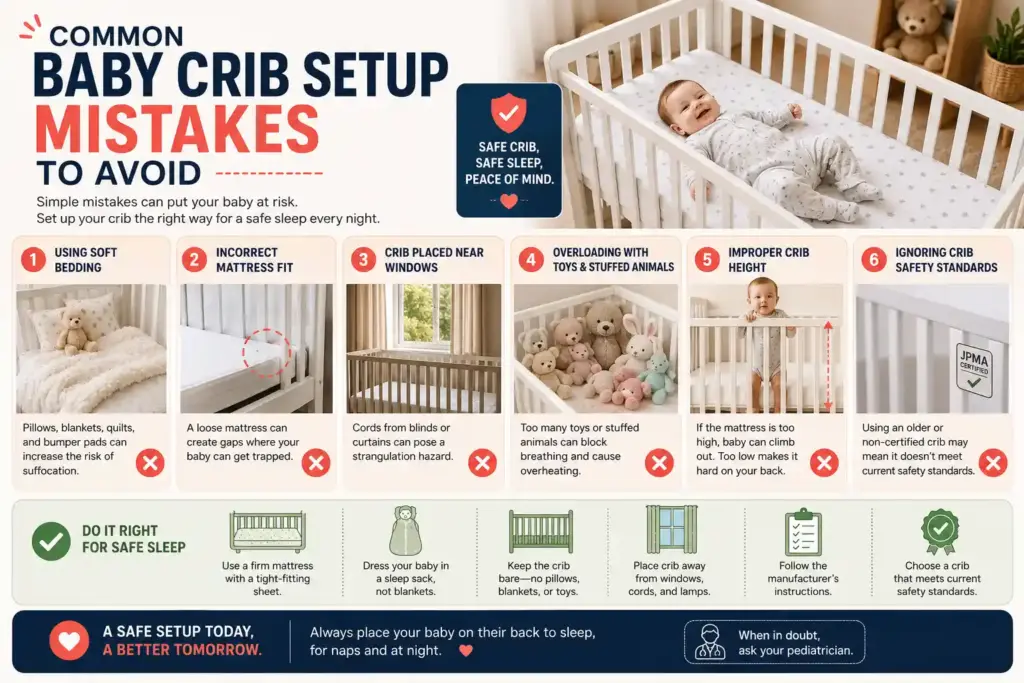
Even well-intentioned parents can overlook small details that affect crib safety. Watch out for these common mistakes:
- Using a mattress that leaves large gaps around the crib edges.
- Adding pillows, blankets, stuffed toys, or bumper pads to make the crib feel “cozier.”
- Placing the crib near windows, blind cords, heaters, or hanging décor.
- Forgetting to tighten screws and hardware after assembly.
- Waiting too long to lower the mattress height as your baby starts sitting or standing.
Many crib-related risks come from setup errors rather than the crib itself, which is why regular safety checks are just as important as the initial assembly.
A Quick Safe Crib Checklist
Before your baby sleeps in their crib, review this checklist:
✓ Crib assembled according to manufacturer’s instructions
✓ All screws and hardware tightened securely
✓ Slats spaced no more than 2⅜ inches apart
✓ Mattress fits snugly with no large gaps
✓ Firm mattress and fitted sheet only
✓ No blankets, pillows, toys, or bumpers
✓ Crib positioned away from windows and cords
✓ No shelves or heavy objects overhead
✓ Appropriate room temperature maintained
✓ Mattress height adjusted for baby’s developmental stage
A Smarter Way to Buy or Rent a Baby Crib
Setting up a safe nursery often means balancing three priorities: safety, quality, and budget. Since a crib is only used for a relatively short stage of childhood, many families look for smarter alternatives to buying everything brand new.
At Coodlè, we make it easy to buy or rent quality secondhand baby cribs through a platform built specifically for parents.
Why Coodlè?
- Buy or rent quality secondhand cribs at a lower cost
- Avoid the uncertainty of generic online marketplaces
- Access baby products designed for growing families
- Support a more sustainable approach to parenting
A practical option many parents choose is to source a high-quality crib frame through Coodlè and pair it with a new, firm infant mattress. This helps maintain modern safety standards while saving money and extending the life of perfectly usable baby furniture.
We believe safe parenting shouldn’t require overspending. With Coodlè, families can create a safe sleep environment while making more budget-friendly and sustainable choices.
Final Thoughts
Setting up a baby crib safely comes down to a few non-negotiable principles: build it correctly, position it wisely, choose a firm mattress, keep the sleep space bare, and adapt the setup as your baby grows.
Many nursery trends prioritise appearance, but safe sleep is built on simplicity. When every safety detail is handled properly, you create an environment that supports healthy sleep and gives you greater confidence as a parent.
Whether you’re furnishing a nursery from scratch or looking for cost-effective ways to source quality baby furniture, focusing on safety first will always be the best investment you can make for your child.
Frequently Asked Questions
Yes, provided the crib meets current safety standards, has no missing parts, and has not been recalled. Always inspect the frame carefully before use and verify the model if possible.
Perform a quick visual check every few weeks and a more thorough inspection monthly. Look for loose hardware, cracks, worn parts, or signs of damage from teething and daily use.
Cosmetic scratches are usually not a safety concern. However, deep bite marks, splintering wood, peeling paint, or damaged rails should be repaired or replaced immediately.
Many parents use a bassinet initially, but a properly set-up crib is safe for newborns from birth. The key is following safe sleep guidelines and using an infant-appropriate mattress.
Use a damp cloth with mild soap and water, then allow all surfaces to dry completely. Avoid harsh chemicals, strong fragrances, or cleaning products that can leave behind residue where your baby sleeps.