
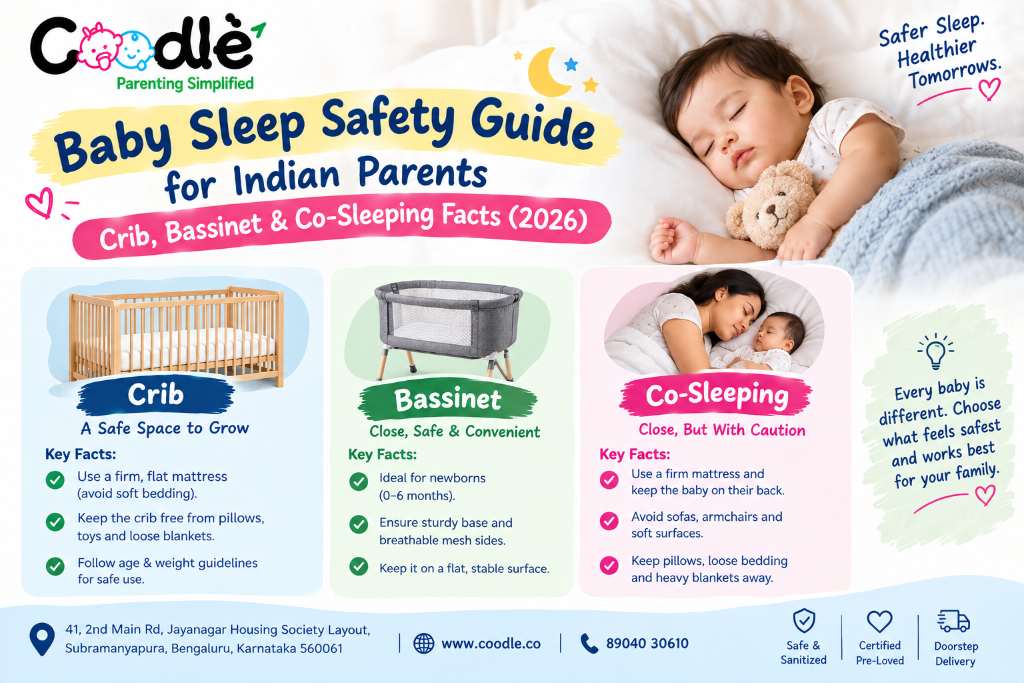
Every new parent’s most urgent concern after bringing a newborn home is whether their baby is sleeping safely. In India, where generational traditions around baby sleep often conflict with modern paediatric guidance, parents are frequently caught between family expectations and evidence-based recommendations.
This guide bridges that gap. Coodlè covers the science of safe infant sleep, explains the difference between cribs, bassinets, and co-sleeping arrangements, addresses the Indian family context honestly, and gives you practical guidance for setting up a safe sleep environment for your baby — whether you’re in a Bangalore apartment or a family home in Mumbai.
This is not a judgement guide. It’s an information guide — designed to help you make informed decisions about the most critical aspect of your newborn’s daily life.
The ABCs of Safe Infant Sleep
The American Academy of Pediatrics — and the Indian Academy of Pediatrics — summarise safe infant sleep in three letters: A, B, C.
✦ A — Alone: Babies should sleep alone, not with adults or siblings. A baby sleeping in an adult bed with another person is at significantly higher risk of suffocation, entrapment, and SIDS.
✦ B — Back: Always place babies on their back for every sleep — naps and night sleep. Back-sleeping reduces SIDS risk by up to 50% compared to stomach or side positions.
✦ C — Crib: Babies should sleep in a crib (or bassinet, play yard, or bedside co-sleeper) that meets safety standards — firm flat mattress, no soft bedding, no bumpers, no pillows.
These three principles apply from birth. They don’t change because of traditional practice, family pressure, or because ‘it seems to work for many people.’ SIDS and sleep-related suffocation happen in safe-looking situations.
Crib vs Bassinet vs Co-Sleeper: Understanding the Options
Baby Crib (Cot)
A full-size, four-sided baby bed with a firm flat mattress and adjustable base height. The most widely recommended sleep surface for babies from birth through 18–24 months. Cribs meeting IS 4223 or EN 716 standards are safe when set up correctly.
✦ Best for: Babies from birth through toddlerhood. Most versatile long-term sleep surface.
✦ Key safety requirements: Firm flat mattress (no memory foam), no soft bedding, slat spacing maximum 6 cm, mattress fit with less than 2-finger gap on all sides.
✦ Indian context: Cribs are often used in a separate nursery or the parents’ bedroom. Both are safe — the crib must meet the ABC principles regardless of room placement.
Bassinet
A small, lightweight baby bed designed for the first 3–6 months. Smaller footprint than a crib, easier to position next to the parents’ bed, and often includes gentle rocking or vibration features.
✦ Best for: The first 3–4 months when babies need frequent night feeds and close parental proximity.
✦ Limitation: Babies typically outgrow bassinets by 3–6 months or when they can roll or push up on their hands.
✦ Key safety requirement: Must have a firm, flat base — not an inclined or hammock-style sleeping surface. Inclined bassinets have been recalled in multiple markets.
✦ Indian context: Bassinets are relatively new to the Indian market. Traditional alternatives include the hanging jhoola — which has different safety considerations (see below).
Bedside Co-Sleeper / Sidecar Crib
A crib or bassinet that attaches or sits directly against the parents’ bed with one side lowered or open, allowing the baby to be within arm’s reach without sharing the sleep surface. This is not bed-sharing — the baby has their own firm sleep surface adjacent to the parents’ bed.
✦ Best for: Parents who breastfeed frequently at night. Provides close proximity without the risks of bed-sharing.
✦ Key safety requirement: The co-sleeper must be firmly attached to the parents’ bed frame or positioned so there is no gap between the surfaces where the baby could fall or become entrapped.
✦ Indian context: Bedside co-sleepers are increasingly popular with urban Indian parents who want close proximity for breastfeeding without the risks of full bed-sharing.
The Indian Hanging Cradle (Jhoola / Palna)
The traditional Indian hanging cradle is a cultural fixture — used across generations in South and North Indian families for its soothing rocking motion. Understanding its safe use is important for families who wish to honour this tradition.
✦ Safety requirements for jhoola use: Must be suspended from a load-bearing point rated for the combined weight of cradle and baby. Suspension chain, rope, or fabric must be in excellent condition with no fraying. The suspension point must prevent lateral swing that could cause the cradle to hit walls or furniture.
✦ Maximum safe use age: Most jhoola designs are suitable for babies up to 3–4 months — after which the baby’s increasingly active movement creates instability risk.
✦ Key limitation: The AAP and IAP both advise against unsupervised sleep in inclined or hammock-style devices. A hanging jhoola is not a safe overnight sleep surface for unsupervised sleep — use it for supervised soothing and daytime rest, with the baby transferred to a flat crib for overnight sleep.
✦ The practical Indian approach: Many families use the jhoola for supervised daytime rocking and soothing, and a crib or co-sleeper for overnight and nap sleep. This honours the tradition while meeting safe sleep standards.
Co-Sleeping: The Indian Reality and the Safety Evidence
Co-sleeping — parents and baby sharing the same sleep surface — is extremely common in India. Surveys suggest 60–80% of Indian infants co-sleep with parents for at least part of the night. This practice is deeply embedded in Indian cultural expectations around closeness, breastfeeding, and family sleep.
The safety evidence is unambiguous: bed-sharing significantly increases the risk of SIDS and sleep-related suffocation. This risk is highest in the first 3 months and with specific risk factors:
✦ Highest risk factors for co-sleeping: Soft mattress or bedding. Parent who smokes (even if not smoking in bed). Parent who has consumed alcohol. Parent who is very tired or taking sedating medication. Overheating. Prematurely born baby. Baby under 3 months.
✦ Lower risk factors (but still elevated vs crib): Firm mattress, no soft bedding, non-smoking, sober parents, full-term baby over 3 months. The IAP does not endorse bed-sharing but acknowledges lower risk in these conditions.
The honest guidance: the safest sleep surface for any baby is their own firm flat sleep surface. If your family co-sleeps and is unwilling to change, minimise risk factors as much as possible — but understand that some elevated risk remains.
Setting Up a Safe Sleep Environment in an Indian Home
Here’s the practical checklist for a safe sleep setup in a Bangalore or Mumbai apartment:
The Crib or Bassinet Setup
✦ Mattress: Firm and flat. Press your hand into the mattress — it should spring back immediately without contouring. Memory foam, very soft foam, or mattresses that show visible depression are not safe.
✦ Bedding: A fitted sheet only. No loose sheets, blankets, quilts, or duvets in the sleep space. If the room is cold, use a baby sleep sack (sleeping bag) instead of a blanket.
✦ No bumpers: Crib bumpers — padded or mesh — should not be used. They create entrapment and suffocation risk as the baby becomes mobile.
✦ No pillows: No pillows in the crib at any age under 2 years. Babies do not need pillows.
✦ No soft toys: Do not place soft toys in the sleep space. A single small attachment toy is acceptable after 6 months — one that is flat and cannot cover the baby’s face.
✦ Temperature: Baby’s sleep environment should be 20–22°C if possible. If using AC in Indian summers, ensure the crib is not in a direct air vent draught. Overheating is a SIDS risk factor.
Room Placement
✦ Same room as parents: Recommended for the first 6 months. This allows prompt response to baby’s needs and has been associated with reduced SIDS risk.
✦ Separate nursery: Safe from birth, but monitor closely with an audio or video monitor. Some families move to a separate nursery after 3–4 months.
✦ Near-to-bed positioning: Placing the crib within arm’s reach of the parents’ bed gives the benefits of close proximity without bed-sharing risks.
Baby Sleep Safety: Indian Context FAQ
Is it safe for a baby to sleep in a jhoola overnight?
The jhoola is a wonderful soothing tool for supervised use. For overnight sleep, transfer the baby to a flat firm surface — a crib or bassinet. Unsupervised overnight sleep in a hanging cradle is not recommended by the IAP or AAP due to position and supervision concerns.
How long can a baby use a bassinet before needing a crib?
Most bassinets are suitable until the baby reaches 5–6 kg, can roll, or can push up on hands — typically 3–5 months. Check your specific bassinet’s weight and developmental limit. After that, a crib is the appropriate sleep surface.
Is co-sleeping safe if I am careful?
The safest sleep surface for any baby is their own firm flat surface. Co-sleeping carries elevated risk even with precautions. If your family co-sleeps, minimise risk by: using a firm mattress, no soft bedding, ensuring no smoking or alcohol, and using a firm surface on a bed without gaps around the edges.
What mattress should I buy for a baby crib in India?
Always buy a new crib mattress — never use a second-hand mattress. Choose a firm, flat model from a certified brand (LuvLap, Mee Mee, Purity). The mattress should fit the crib with no more than a 2-finger gap on any side.
Can I rent a safe baby crib in Bangalore?
Yes. Coodlè rents certified baby cribs starting from ₹850/month, delivered same day across Bangalore. Every crib goes through a 15-point safety inspection and hygiene process before delivery.
At what age can a baby start sleeping on their stomach?
Babies placed on their back can roll to their stomach independently from around 4–6 months. Once a baby can roll both ways independently, stomach sleeping is no longer a SIDS risk — but always place them on their back to start sleep until this developmental milestone is reached.
Safe Sleep Is the Best Start
Safe infant sleep is not about Western parenting trends overriding Indian tradition. It’s about understanding that infant physiology — particularly the breathing and arousal mechanisms of very young babies — makes certain sleep environments genuinely dangerous, and others genuinely safe.
A firm flat sleep surface in a safe crib or bassinet, in the same room as parents, with no soft bedding — this is what the evidence supports. A rented, certified crib from Coodlè makes this safe setup accessible from day one, without a large upfront purchase.