
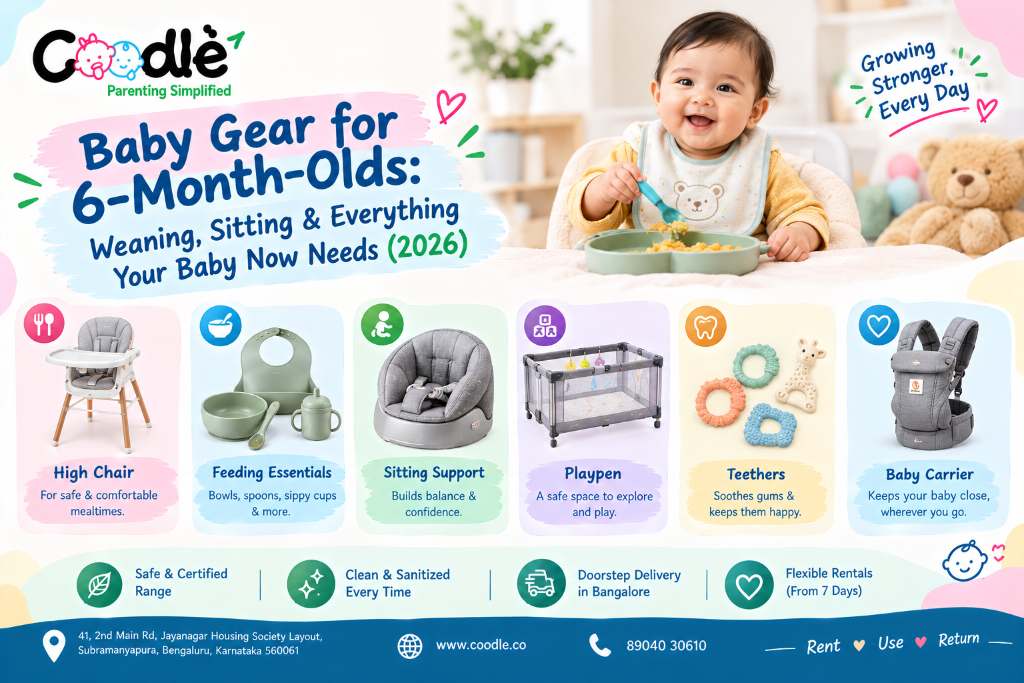
Six months is one of the most exciting milestones in your baby’s first year — and one of the biggest shifts in what baby gear you actually need. Almost overnight, your baby moves from a sleepy, mostly-held newborn into a sitting, grabbing, solids-eating little person with opinions. The gear that served the newborn stage no longer covers these new needs.
This guide explains exactly what changes at six months and which baby gear becomes essential: the highchair for weaning, the playpen for safe sitting and play, and the transition your stroller and sleep setup go through. As always, it is written for the Indian context — apartment sizes, family setups, and the rent-versus-buy maths that makes the most sense here.
If you followed our newborn (0–3 month) gear guide by Coodlè, this is the natural next step. Your gear needs are about to expand — but with the right approach, you can meet all of them without overspending on products your baby will use for only a year or so.
What Changes at 6 Months? The Three Big Developmental Shifts
Understanding why your baby needs new gear at six months helps you buy — or rent — only what genuinely matches their development. Three things happen around this age:
✦ Starting solids (weaning): The World Health Organization and Indian paediatricians recommend introducing solid foods at around six months. This immediately creates the need for a safe, supportive feeding chair.
✦ Sitting up: Most babies begin sitting with support around six months and independently by seven to eight months. A sitting baby wants to be upright and engaged with the world — and needs a safe space to do it.
✦ Becoming mobile: Rolling, and soon crawling, means your baby can move — which means baby-proofing and a contained safe zone suddenly matter. This is where the playpen becomes invaluable.
Essential #1: A Highchair for Starting Solids
The highchair is the defining new purchase of the six-month stage. Starting solids is messy, joyful, and daily — and a proper highchair makes it safe and manageable. Your baby will use a highchair multiple times a day for roughly 12–18 months, from six months until they transition to a booster or regular chair around two years.
What to Look For in a Highchair
✦ 5-point harness: Essential for babies under 18 months. A shoulder-plus-waist-plus-crotch harness stops your baby sliding down or standing up. A waist-only strap is not enough at this age.
✦ Footrest: A supported foot position helps posture and lets your baby focus on eating rather than balancing. Look for an adjustable footrest.
✦ Easy-clean tray: Weaning is messy. A removable, wipe-clean or dishwasher-safe tray with no deep food-trapping grooves saves you enormous cleaning effort.
✦ Stable base: A wide, anti-tip base keeps an increasingly wriggly baby safe.
Should You Rent or Buy a Highchair?
Because a highchair is used for a defined 12–18 month window and then retired, it is an ideal rental. Renting a hygiene-certified highchair means you avoid paying full price for a bulky item you will need to store or resell within two years. It also means the harness, tray, and seat have been professionally cleaned — which matters for a product covered in food every day. See the linked guide on baby highchair rental in Bangalore for current options and pricing.
Essential #2: A Playpen for Safe Sitting and Play
Once your baby can sit and is starting to move, you cannot watch them every second — and you should not have to. A playpen gives your baby a safe, contained space to sit, play, and explore while you cook, work, shower, or simply catch your breath. It is one of the most practical pieces of gear for the 6–18 month stage.
What to Look For in a Playpen
✦ Minimum 75 cm panel height: Tall enough that an early climber cannot hook their arms over and topple out.
✦ Fine breathable mesh: Lets you see your baby and keeps airflow in India’s warm climate, while being fine enough that small fingers and buttons cannot get caught.
✦ Firm flat floor mat: A firm base is safe; avoid overly soft padding, especially for younger sitting babies.
✦ Secure locking joints: Every panel and fold must lock positively so the playpen cannot collapse inward.
Rent or Buy a Playpen?
Playpens have one of the widest variances in how long babies actually use them — some love the playpen and use it daily for a year, others reject it within weeks. This variability alone makes renting the smart first move: you avoid a ₹5,000–₹8,000 purchase your baby might refuse. Renting a playpen lets you test whether your baby takes to it before committing. See the linked baby playpen rental guide for details.
How Your Existing Gear Changes at 6 Months
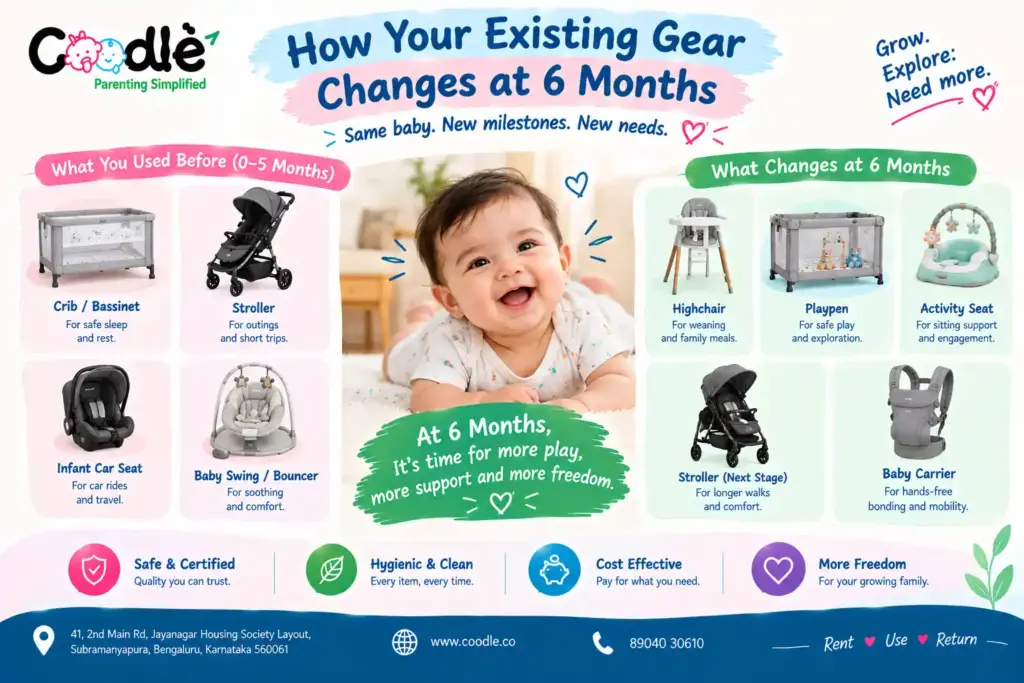
Stroller: From Flat to Upright
Your newborn stroller was used mostly reclined. Now your sitting baby wants to face the world upright and take in their surroundings. If your rented stroller has adjustable recline, simply move it more upright. If you started with a strict newborn pram, this is a good moment to switch to a more versatile stroller — another advantage of renting, since you can swap models as your baby’s needs change.
Sleep: Toward a Full Crib
If your baby started in a bassinet or co-sleeper, six months is around when many outgrow it — most bassinets are rated only to about 5–6 kg or until the baby can push up. A full-size crib becomes the appropriate sleep surface. Again, renting means you can transition from a small newborn sleeper to a full crib without buying both.
Car Seat: Still Rear-Facing
Your car seat does not change yet. A six-month-old should remain rear-facing — this is the safest position and should continue until your baby reaches the seat’s rear-facing weight or height limit, typically well beyond the first year. If you rented an infant carrier seat, check whether your baby is approaching its limit and plan a swap to a convertible seat when needed.
The Complete 6-Month Gear Table: Rent, Buy or Adjust
Gear Item | Action at 6 Months | Why |
|---|---|---|
RENT (new need) | Used 12–18 months then retired; messy — cleaning matters | |
RENT (new need) | Wide usage variance — test before buying | |
ADJUST to upright / swap model | Sitting baby wants upright; renting lets you swap | |
TRANSITION from bassinet | Bassinet outgrown ~6 months; move to full crib | |
KEEP rear-facing | Still safest; swap to convertible near the limit | |
Feeding — solids | BUY bowls, spoons, bibs | Low-cost personal items for weaning |
Baby walker (wheeled) | SKIP | Paediatricians advise against wheeled walkers |
Activity gym | RETIRE | Outgrown — 0–5 month product |
Weaning Feeding Supplies to Buy (Not Rent)
Alongside the highchair, starting solids needs a few small, personal-use items that you should buy rather than rent:
✦ Baby bowls and soft-tip spoons: Soft silicone spoons are gentle on new gums.
✦ Bibs: Several — weaning is messy. Silicone catch-bibs with a pocket are easiest to clean.
✦ A sippy or open cup: For introducing water alongside solids at six months.
✦ Food storage containers: For batch-prepared purees and finger foods.
How Much Does 6-Month Baby Gear Cost — Rent vs Buy?
Item | Buy New (approx.) | Rent (per month) |
|---|---|---|
Highchair | ₹3,500 – ₹12,000 | From ₹1,000/month |
Playpen | ₹5,000 – ₹8,000 | From ₹1,100/month |
Full crib (if transitioning) | ₹8,000 – ₹15,000 | From ₹850/month |
Weaning supplies (buy) | ₹1,500 – ₹3,000 | n/a (buy) |
Renting the highchair and playpen for the year or so they are used costs far less than buying both new — and you avoid the storage and resale problem entirely. When your baby outgrows them, you simply return the gear.
A Simple 6-to-12-Month Gear Timeline
✦ 6 months: Introduce the highchair as solids begin. Set up a playpen as your baby starts sitting. Move the stroller to upright.
✦ 7–8 months: Independent sitting arrives; the playpen becomes a daily safe zone as crawling begins. Baby-proof accessible areas.
✦ 9–10 months: Pulling to stand begins. Lower the crib mattress to its lowest setting. The playpen contains an increasingly mobile baby.
✦ 11–12 months: Approaching the one-year stage — walking, ride-ons, and the next gear shift, covered in the linked 1-year baby gear guide.
Frequently Asked Questions — Baby Gear for 6-Month-Olds in India
What baby gear does a 6-month-old need in India?
A six-month-old needs two new essentials: a highchair for starting solids and a playpen for safe sitting and play. Alongside these, the stroller shifts to upright use, the sleep setup transitions from bassinet to a full crib, and the car seat stays rear-facing. Renting the highchair and playpen is the most cost-effective choice because both are used for only about a year.
At what age should a baby start using a highchair?
Most babies start using a highchair at around six months, which is when paediatricians recommend introducing solid foods. The baby should be able to sit with support and hold their head steady. Choose a highchair with a 5-point harness and a footrest for babies under 18 months.
Should I rent or buy a highchair for my baby?
Renting is usually the better choice. A highchair is used for a defined 12–18 month window and is one of the messiest baby items, collecting food in every crevice. A professionally cleaned rented highchair — with the harness removed and machine-washed — is more hygienic than an unverified second-hand chair, and renting avoids paying full price for a bulky item you will soon retire.
When can a baby start using a playpen?
Babies can begin using a playpen from around five to six months, once they can sit with some support. The playpen becomes most useful from six months onward as the baby starts sitting independently and then crawling, giving them a safe contained space. Peak playpen use is roughly six to eighteen months.
Is a playpen worth it or a waste of money?
A playpen is genuinely useful for many families as a safe space during the mobile 6–18 month stage — but babies vary enormously in whether they take to one. Because of this variance, renting a playpen first is smart: you avoid a ₹5,000–₹8,000 purchase your baby might reject, and you can return it if it does not suit your child.
What feeding gear do I need to start weaning at 6 months?
For starting solids you need a safe highchair with a 5-point harness, baby bowls, soft-tip silicone spoons, several bibs (catch-bibs are easiest to clean), and a cup for introducing water. The highchair is best rented; the small feeding items are inexpensive personal purchases you should buy.
Does my baby still need a rear-facing car seat at 6 months?
Yes. A six-month-old should remain in a rear-facing car seat, which is the safest orientation. Rear-facing should continue until your baby reaches the seat’s rear-facing weight or height limit, typically well beyond the first birthday. If you rented an infant carrier seat, plan to swap to a convertible seat as your baby approaches its limit.
How much does baby gear for a 6-month-old cost in India?
Buying a highchair and playpen new costs roughly ₹8,500–₹20,000 combined, plus a crib if transitioning from a bassinet. Renting the highchair (from ₹1,000/month) and playpen (from ₹1,100/month) for the year they are used costs far less overall and removes the storage and resale burden.
What baby gear should I stop using at 6 months?
By six months you can retire the newborn activity gym (a 0–5 month product) and, if outgrown, the bassinet — most are rated only to about 5–6 kg or until the baby can push up. This is the point to transition to a full crib. Wheeled baby walkers should be avoided entirely, as paediatricians advise against them.
Can I rent a highchair and playpen together in Bangalore with same-day delivery?
Yes. Coodlè offers both highchairs and playpens for rent across Bangalore, with same-day delivery for orders placed before noon and a 100% refundable deposit. Both items are hygiene-certified before delivery — the harness and fabric on the highchair are machine-washed and sanitised, which is especially important for weaning gear.
The Bottom Line
Coodlè Six months brings a joyful leap in your baby’s development and a clear shift in gear needs. The two new essentials — a highchair for weaning and a playpen for safe sitting — are both used for about a year and are ideal candidates for renting rather than buying. Add a few inexpensive weaning supplies, adjust your stroller to upright, transition to a full crib, and you have everything a six-month-old genuinely needs.
Meet each stage as it comes, rent the items with short use windows, and you will give your baby everything they need without overspending on gear that is outgrown within a year.