
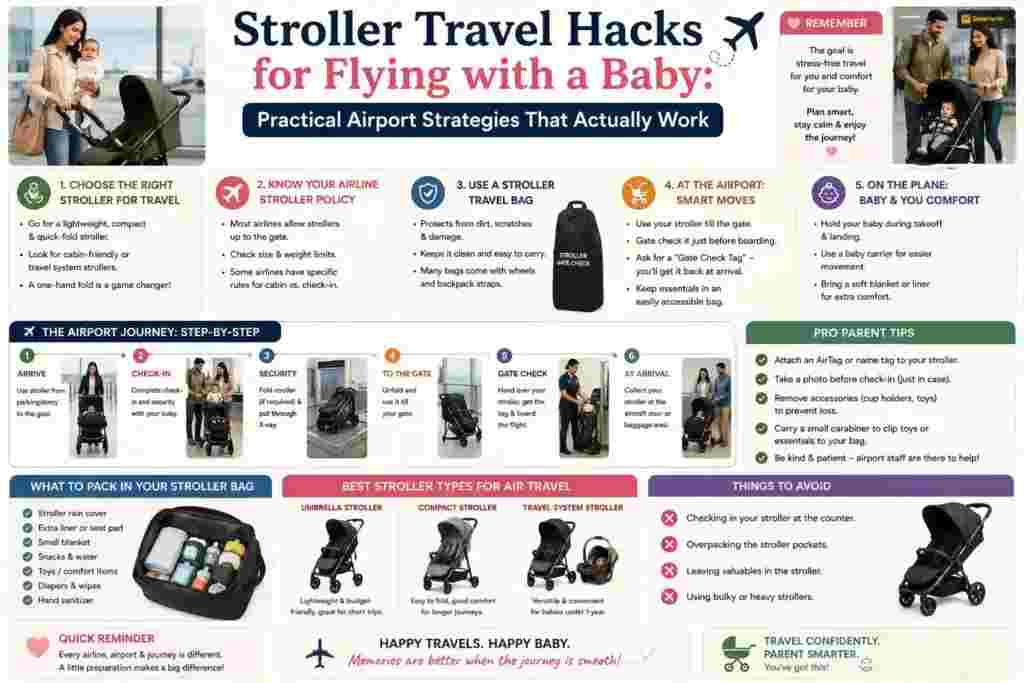
The best stroller travel hacks for flying with a baby are surprisingly simple: choose the right stroller, use it strategically through the airport, and know exactly when to gate-check it or take it onboard. These decisions have a bigger impact on your travel experience than the flight itself, influencing everything from security screening to boarding and arrival.
The real challenge begins at the airport, where timing, baggage handling, and stroller logistics can either simplify your journey or leave you managing a tired baby, carry-on luggage, and a folded stroller at the jet bridge. What many parents underestimate is that stroller handling during air travel is not just about convenience. It is about reducing delays at security, protecting your gear from damage, and ensuring your baby has a comfortable place to rest right up until boarding.
Before the Airport: Choosing Your Stroller Strategy
Your stroller decision should start with one question: do you want cabin storage or gate check flexibility? These are not interchangeable once you reach the airport.
Most airlines accept one stroller per infant without additional charges, but handling depends on size and foldability. Broadly, you are choosing between three operational paths:
- Ultra-compact cabin strollers: Fold small enough for overhead bins (typical cabin limits are around 56 × 35 × 22 cm, though airline rules vary).
- Standard travel strollers: Used through the airport, then gate-checked before boarding.
- Full-size strollers: Usually checked at the counter and unavailable until baggage claim.
If you are flying frequently or value minimal waiting time after landing, compact cabin-approved strollers significantly reduce dependency on baggage handling timelines. If you are traveling occasionally, gate-checking a reliable foldable stroller is often more practical.
At this stage, many parents face a cost-versus-use problem. Premium compact strollers are excellent in performance but expensive relative to how often they are used. This is where we at Coodlè help solve a common travel challenge for parents.
Instead of treating stroller purchase as a one-time retail decision, we see it as a usage-based requirement. At Coodlè, we offer parents the flexibility to rent premium travel strollers for short trips or purchase verified models without navigating inflated retail pricing. For families who travel occasionally, this approach prevents expensive equipment from sitting unused at home.
At the Terminal: Navigating Security and Managing Movement
The airport terminal is where stroller inefficiencies become obvious. Security queues, documentation checks, and baggage handling require constant transitions.
A key operational move is using a baby carrier during security screening. It keeps your hands free and avoids early folding of the stroller. You can place the stroller on the belt separately and carry your baby through without disrupting your flow.
Once you clear security, the goal shifts to energy management. Babies often become overstimulated in airports, and sitting in a stroller for long periods increases resistance at boarding time.
A more effective approach is:
- Let your baby move or walk safely in designated areas near the gate
- Use stroller time selectively for rest or feeding
- Avoid keeping them restrained right before boarding unless they are already asleep
This helps reduce the “restless boarding effect,” where babies are physically tired but mentally overstimulated.
If you are using a stroller with extra storage space, the terminal phase is also where organization matters. Keep essentials accessible:
- Diapers for quick changes
- A light blanket for temperature control
- One comfort toy to reduce overstimulation
- Snacks that do not require preparation
Overpacking the stroller basket often leads to disorganization at the gate when you need to fold it quickly.
At the Airplane Door: Gate Check vs. Cabin Storage Decision
This is the most critical decision point in your entire stroller journey.
Gate Check Strategy
Gate checking is the most commonly used method. You use the stroller until the aircraft door, hand it over before boarding, and retrieve it either at the aircraft door after landing or at baggage claim, depending on airport handling systems.
Advantages:
- Full use of stroller inside the airport
- No need to carry baby through boarding lines
- Suitable for heavier or mid-size strollers
Limitations:
- Waiting time after landing can range from 10–30 minutes
- Risk of minor scratches or handling damage
- Not ideal for tight layovers
A key detail many parents miss is that gate-checked strollers are exposed to rapid handling transitions. Using a protective stroller travel bag reduces surface damage significantly, especially on international routes.
Cabin-Approved Strollers
If your stroller folds into cabin dimensions, you can carry it onboard and place it in overhead storage. This removes dependency on baggage systems entirely.
Advantages:
- Immediate access after landing
- No risk of baggage damage
- Faster airport exit
Limitations:
- Strict size compliance required
- Limited overhead bin space competition
- Not all aircraft types support full storage
This is where product selection matters significantly. Ultra-compact travel strollers are designed specifically for this purpose, but they are a higher investment category. For families who want flexibility without committing to expensive purchases, Coodlè becomes a practical alternative again—either for renting high-end cabin strollers or selecting certified models suited for frequent travel.
Protecting Your Gear: Preventing Damage and Loss
Stroller damage during air travel is more common than most parents expect. It usually occurs during loading, unloading, or transport between aircraft and baggage carts.
A structured protection approach reduces risk significantly:
- Use a padded stroller travel bag for gate check
- Avoid leaving detachable accessories attached (cup holders, trays, hooks)
- Secure folding locks before handing over the stroller
- Place a Bluetooth tracker inside a zipped compartment rather than hanging it externally
The last point is particularly important. External tags or trackers can detach during handling, while internal placement ensures the device remains secure even if the stroller is moved between multiple transfer points.
If you are traveling with a rental or premium stroller, protective handling becomes even more important. Through Coodlè, parents often access high-value strollers, making proper protection not just optional but essential for maintaining condition across multiple users.
Comfort Strategy: Reducing Stress for Your Baby in Transit
Comfort during flight travel is not only about seating—it starts at the airport.
A practical approach includes:
- Allowing movement before boarding to reduce restlessness
- Timing naps closer to boarding or takeoff
- Maintaining familiar comfort objects like blankets or soft toys
- Keeping feeding schedules aligned with takeoff or landing pressure changes
Babies respond strongly to overstimulation in airports. Keeping them engaged without over-restricting movement helps reduce in-flight discomfort and improves sleep consistency.
Buying vs Renting Premium Strollers: A Practical Decision Layer
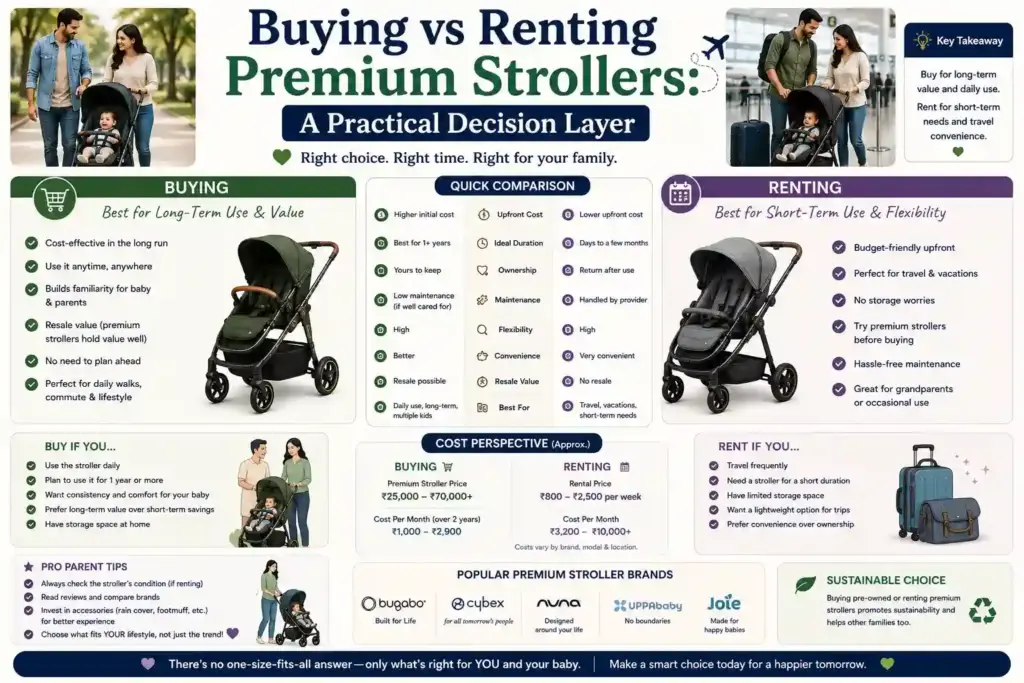
The most overlooked part of stroller travel planning is long-term usage value. Premium travel strollers perform exceptionally well but are often underutilized outside travel periods.
This creates a simple question: is ownership necessary for occasional travel?
We often guide parents to evaluate based on frequency:
- Frequent travelers (4–6 trips/year): Ownership of a premium cabin stroller may be justified
- Occasional travelers (1–2 trips/year): Renting is more cost-efficient and practical
- One-time international trips: Renting eliminates unnecessary long-term storage
This is where we at Coodlè help bridge a real gap in parenting and travel logistics. Instead of forcing a purchase decision, it provides access to premium strollers on demand. Parents can rent high-performance travel strollers for the exact duration of their trip or buy verified models when they decide to invest long-term.
The key advantage is flexibility. You are not locked into ownership costs for equipment that may only be relevant during specific travel windows.
Final Operational Insight: Travel Light, Not Just Prepared
The difference between a stressful airport experience and a controlled one often comes down to stroller decisions made before leaving home. Every step—from security to boarding—becomes easier when your stroller strategy matches your travel style.
A well-chosen stroller reduces physical strain, speeds up transitions, and ensures your baby has a stable environment even in unpredictable airport conditions. Whether you choose to rent or buy, the goal is the same: reduce unnecessary handling and keep movement predictable.
For families looking to optimize this entire experience without committing to high upfront costs, we recommend exploring Coodlè as a practical platform to access premium strollers, either through rental or purchase options. It aligns well with the reality of modern travel—flexible, occasional, and efficiency-driven.
Frequently Asked Questions
Yes. Most airports allow baby formula, breast milk, and baby food in quantities exceeding standard liquid limits when traveling with an infant. Keep them separate for easier screening.
Report the damage to the airline before leaving the airport. Taking photos immediately and keeping your baggage tags can help support any compensation or repair claims.
Airport strollers can be useful during transit, but availability is not guaranteed. Having your own stroller ensures consistent comfort, familiarity, and support for naps throughout your trip.
Yes, especially for trips involving connections or unpredictable weather. A compact rain cover protects your stroller while waiting on the tarmac, jet bridge, or during outdoor transfers.
It depends on the stroller’s weight capacity, recline options, and support features. Before traveling, check that it still matches your child’s size, comfort needs, and sleeping habits.