
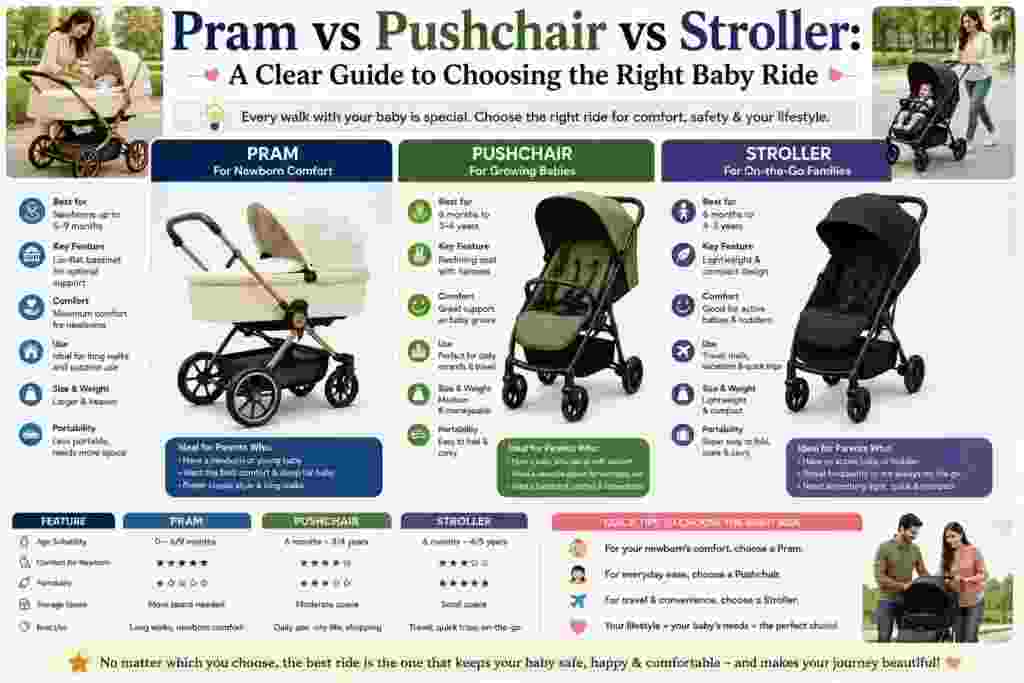
A pram is designed for newborns to lie flat, a pushchair is for babies who can sit with recline support, and a stroller is a lightweight, compact option for toddlers on the move.
Choosing a pram, pushchair, or stroller is less about brand names and more about understanding how your baby’s needs change in the first few years. While they may look similar at first glance, each one serves a very specific stage of growth and daily use.
When you understand these differences properly, you avoid overspending, unnecessary upgrades, and safety compromises. In this guide, we break everything down Pram vs Pushchair vs Stroller about in a practical, experience-led way so you can make a confident decision.
Quick Comparison: Pram vs Pushchair vs Stroller
Before going deeper, here’s a simple overview that helps you see the core differences in one place.
| Feature | Pram | Pushchair | Stroller |
| Best Age | Birth to 6 months | 6 months to toddler stage | 1 year and above |
| Baby Position | Fully flat (lie-down) | Upright with recline options | Upright seating |
| Purpose | Newborn sleep and support | Daily walking and comfort | Travel and quick mobility |
| Design | Bulky and sturdy | Balanced and adaptable | Lightweight and compact |
| Best Use Case | Short, calm walks | Regular outings | Travel, shopping, city movement |
This table already tells an important story: each product is not a variation of the same thing, but a response to a completely different stage of childhood.
1. Pram: Designed for Newborn Safety and Early Development
A pram is built specifically for newborns who cannot yet hold their head or neck properly. At this stage, your baby spends most of the time sleeping, and body alignment becomes more important than mobility.
A fully flat position is not just comfort-focused; it supports early spinal development and keeps the airway naturally open. For this reason, a pram uses a true 180-degree flat surface, which ensures the baby lies completely horizontal. Even a slight incline in early months can cause a newborn’s relatively heavy head to tilt forward toward the chest, which is why a flat carry position is considered essential in the first stage of life.
That is why prams are often used like a “mobile crib” rather than a travel tool.
However, this comfort comes with a trade-off. Prams are heavier, wider, and less practical for tight spaces or frequent transport.
Key practical insights about prams
- Designed for babies from birth to around 6 months
- Prioritises a completely flat sleeping position
- Offers strong stability but limited portability
- Best suited for short outdoor walks and home-area use
- Often occupies more storage space in homes and cars
From a real-world parenting perspective, a pram is a short-term but important investment. Because this protective phase passes so quickly, we offer premium prams for short-term rental at Coodlè, so you don’t have to invest in a permanent purchase you’ll only use for a few months.
2. Pushchair: The Everyday Companion After 6 Months
Once your baby develops sufficient neck strength and can sit completely unassisted while holding their head steady for extended periods, the pushchair becomes the more practical choice. This transition typically happens around the six-month mark, but readiness is always based on physical control rather than age alone.
Unlike prams, pushchairs are designed to support both sitting and reclining positions. This flexibility allows your child to explore the world while still being able to nap comfortably during longer outings.
Pushchairs also tend to balance comfort with usability. They are easier to steer than prams but still sturdy enough for daily routines.
Why pushchairs have become a daily essential
- Suitable for infants who can sit upright without support
- Adjustable recline supports both rest and active viewing
- Works well for longer walks and regular outdoor use
- Often includes better suspension for uneven pavements
- More compact than prams but still not ultra-light
In everyday life, pushchairs become your “main vehicle.” Since a reliable pushchair will be your daily workhorse for years, it is often a gear piece worth long-term ownership. At Coodlè, we carefully curate and safety-vet our pushchairs so you can buy a system that lasts your family a lifetime.
3. Stroller: Lightweight Convenience for Active Travel
A stroller is designed for portability above everything else. By the time your child is a toddler, the need for full-time seating support reduces, and convenience becomes the priority.
Strollers are significantly lighter than both prams and pushchairs. They fold quickly, fit into tight car boots, and are ideal for travel-heavy families or urban environments.
While they may not offer the same cushioning or deep recline features, they are engineered for smooth, predictable surfaces rather than varied outdoor terrain. Most strollers use small, solid plastic or polyurethane wheels with minimal or no shock-absorbing suspension, which means bumps and uneven pavements are felt more directly through the frame.
What makes strollers different in real life
- Best suited for toddlers who can sit independently
- Extremely lightweight and easy to carry or lift
- Compact folding mechanism for travel and storage
- Ideal for airports, malls, and crowded public spaces
- Less suitable for rough or uneven terrain due to limited suspension and smaller wheels
In simple terms, a stroller is not a replacement for a pushchair. It is a mobility-focused tool for families who prioritise ease of movement over long-duration comfort.
Understanding the Real Progression: How Parents Actually Use Them
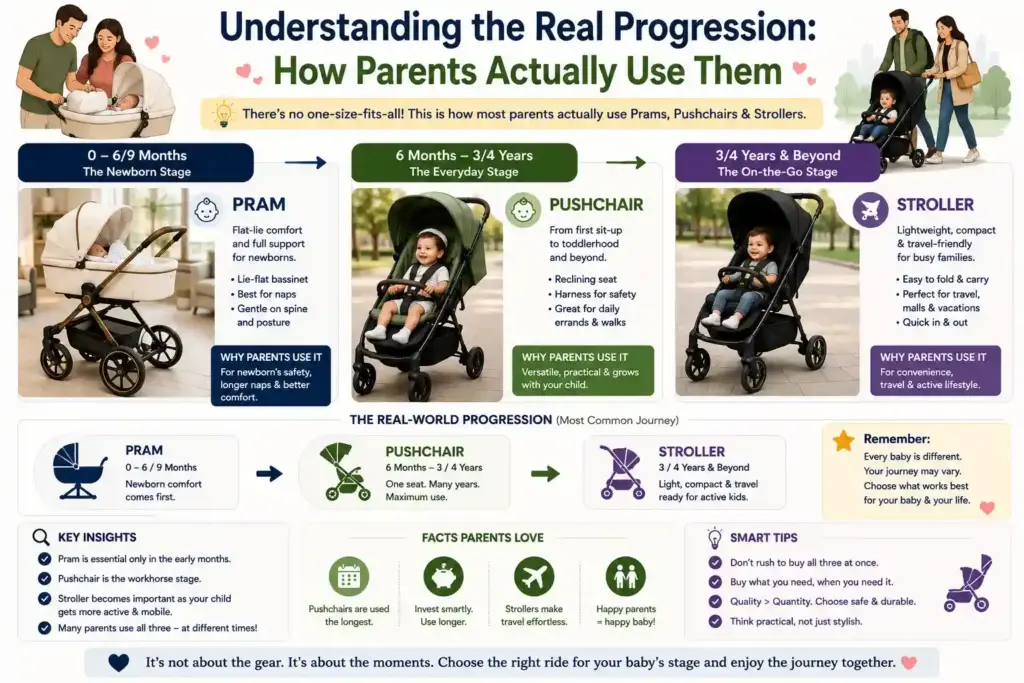
Most families do not stick to just one option. Instead, these products form a progression based on the child’s development.
- First stage: Pram for newborn safety and sleep
- Second stage: Pushchair for daily outings and growth
- Third stage: Stroller for travel and convenience
This progression explains why choosing only based on price or appearance often leads to regret. The better approach is to match the product with your current phase of parenting
Practical Factors You Should Always Consider
Beyond definitions, real-life usage depends on practical details that are often overlooked.
Space and storage
Prams take up significant space and are harder to store in smaller homes. Pushchairs and strollers are more manageable, especially if you frequently travel by car or public transport.
Lifestyle and mobility
If your routine involves daily walks in parks or neighbourhoods, a pushchair becomes more relevant. If you travel often or move through crowded areas, a stroller becomes more practical.
Terrain and surface
Prams are best on smooth surfaces. Pushchairs handle mixed terrain better. Strollers perform best in urban, flat environments.
Longevity of use
Prams have the shortest usage window. Pushchairs last longer. Strollers extend usability into toddler years, but with simpler features.
A Smarter Way to Invest in Baby Gear
One of the most overlooked challenges for parents is cost versus usage duration. A pram, for example, is used for only a few months, yet it often requires a significant investment.
This is where we at Coodlè help you think differently. Instead of locking yourself into expensive one-time purchases, we offer a flexible way to access high-quality prams, pushchairs, and strollers based on your actual needs.
You can choose to rent premium baby gear for short phases or buy when long-term use makes sense. This approach not only reduces waste but also ensures you always have access to clean, safety-checked, and development-appropriate equipment without cluttering your home.
With Coodlè, you align your baby’s growth stages with practical, cost-effective mobility solutions rather than oversized permanent purchases.
Final Perspective: Choosing What Actually Fits Your Life
Understanding the difference between a pram, pushchair, and stroller is really about matching each one to a specific stage of your child’s growth rather than looking for a single “best” option.
A pram is best for newborns who need a flat, supportive sleeping position. A pushchair is the most practical all-round choice for everyday use once your baby can sit. A stroller is best when portability and quick movement matter more than full comfort features.
There is no one winner among them because each serves a different purpose at a different time. The best choice is the one that fits your child’s current stage and your daily routine without making travel or storage difficult.
When you choose this way, you avoid unnecessary spending and constant upgrades. And if you want that flexibility without owning multiple bulky items, platforms like Coodlè make it easier to buy or rent exactly what you need, when you need it.
FAQs
Yes, but only if the pushchair has a fully flat recline or a compatible carrycot attachment. Without that, it won’t provide the necessary flat sleeping position newborns need.
Most children use a stroller up to 3–4 years, depending on how active they are and how often they need rest during outings. Some families stop earlier once the child walks comfortably longer distances.
Travel systems can be more practical because they combine multiple stages in one frame. However, they may feel bulkier, so they suit parents who prefer continuity over ultra-light portability.
Look for a secure harness system, stable braking, and strong frame locking mechanisms. Also, ensure good wheel suspension if you plan to use it on uneven or outdoor surfaces.
Yes, mainly in cleaning and wear handling. Prams need careful fabric cleaning due to newborn use, while strollers require more frequent checks on folding joints because they are used more on the go.